
Metal finishing for steel threaded studs must provide corrosion protection without preventing nut assembly, changing preload, or reducing the mechanical reliability of the fastener. A finish that performs well on a flat steel plate may create excessive buildup, uneven friction, or hydrogen-embrittlement risk when applied to threads.
The correct finish depends on stud strength, service environment, required corrosion resistance, and assembly method.
Start with the Stud’s Function
Before choosing a coating, define how the threaded stud will be installed and loaded. Important questions include:
- Is the stud permanently installed or regularly removed?
- Will both threaded ends receive nuts?
- Is one end installed with thread-locking adhesive?
- Does the stud require an electrical ground?
- Will it experience salt, chemicals, or high temperature?
- Is tightening controlled by torque or direct tension?
- Does the stud have a high-strength property class?
These conditions determine whether the priority is corrosion resistance, stable friction, electrical conductivity, appearance, or temperature resistance.
Prepare the Threads Without Damaging Them
Oil, scale, rust, machining residue, and embedded abrasive particles must be removed before finishing. However, aggressive blasting or pickling can alter thread crests and roots.
The cleaning process should reach the thread flanks without rounding the profile. After preparation, inspect for:
- Damaged thread crests
- Burrs at the stud ends
- Rolling or cutting laps
- Corrosion pits
- Grinding contamination
- Bent studs
A coating cannot repair damaged threads. Defects beneath the finish may become initiation points for fatigue cracking or corrosion.
Choose the Appropriate Finish
Zinc and Zinc-Nickel Plating
Electroplated zinc is economical and suitable for general indoor or moderately corrosive service. Zinc-nickel normally provides stronger corrosion resistance and can be combined with passivation, sealers, topcoats, and lubricants.
ISO 4042 specifies electroplated coating systems for steel fasteners, including studs, and gives requirements related to dimensional properties and hydrogen-embrittlement risk. ISO 4042:2022
Electroplating should be selected carefully for high-strength studs because cleaning and plating processes may introduce hydrogen.
Zinc Flake Coating
Zinc flake systems are non-electrolytically applied and can provide strong corrosion protection with controlled friction. They are often considered for high-strength fasteners where internal hydrogen embrittlement must be minimized.
ISO 10683 covers zinc flake coating systems for bolts, studs, nuts, and other fasteners, with optional topcoats and lubricants. ISO 10683:2018
The coating process must avoid filling thread roots or producing thick deposits at the stud ends.
Black Oxide and Phosphate
Black oxide provides a dark appearance and limited protection unless combined with oil, wax, or another sealant. Phosphate coatings can retain lubricant and support consistent assembly, but they are not normally sufficient for severe outdoor corrosion without additional protection.
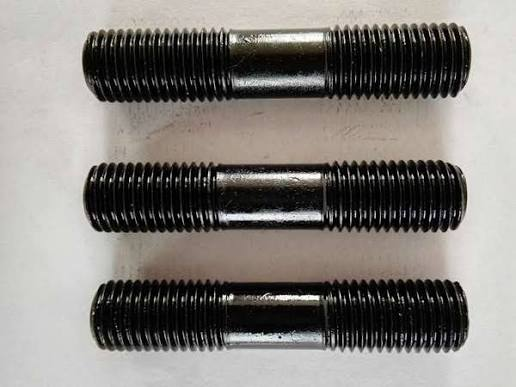
These treatments suit controlled indoor environments better than marine or chemical exposure.
Hot-Dip Galvanizing
Hot-dip galvanizing provides a thick sacrificial zinc layer for outdoor steel structures. Because the coating is relatively thick, the stud and mating nut must be designed with suitable thread allowances.
A standard unmodified nut may not fit correctly after galvanizing. The complete stud-and-nut system should be specified rather than coating each component independently.
Control Coating Thickness on the Threads
Threaded studs are sensitive to dimensional buildup. Coating accumulates on crests and flanks, reducing available clearance between the stud and nut.
Excessive thickness can cause:
- Difficult nut installation
- Coating removal during tightening
- High or inconsistent torque
- Thread galling
- Incorrect preload
- Damaged thread gauges
Coating thickness should be included in the original thread tolerance. Chasing the threads after coating removes corrosion protection and should not be used as a routine correction method.
Control Hydrogen-Embrittlement Risk
High-strength steel studs can fail unexpectedly when hydrogen enters the material and remains under tensile stress. Risk depends on material strength, residual stress, cleaning, electroplating, and time under load.
Possible controls include:
- Avoiding unnecessary acid pickling
- Using mechanical cleaning where appropriate
- Applying qualified post-plating baking
- Selecting non-electrolytic zinc flake coatings
- Controlling hardness and residual stress
- Performing process verification tests
Post-plating baking reduces risk but does not guarantee that every absorbed hydrogen atom has been removed. The complete manufacturing route must be qualified.
Specify Friction, Not Only Corrosion Resistance
Most tightening torque is consumed by friction in the threads and under the nut. Changes in coating, sealer, or lubricant can therefore produce large changes in clamp force.
A dry zinc-plated stud, lubricated zinc-flake stud, and phosphate-oiled stud should not automatically use the same torque value.
The supplier should define:
- Coating system
- Topcoat or sealer
- Lubricant
- Target friction range
- Mating nut finish
- Washer condition
- Approved tightening procedure
Torque–clamp testing should use actual production studs, nuts, and washers.
Mask Functional Areas When Necessary
Some stud surfaces may need to remain uncoated. Examples include welded ends, electrical grounding areas, adhesive-bonded threads, and precision locating diameters.
Masking boundaries should remain away from highly stressed thread roots. Poor masking can create thick edges, exposed corrosion paths, or partial thread coverage.
If only one end requires corrosion protection, the transition between coated and uncoated areas should be clearly shown on the drawing.
Inspect the Finished Studs
Final inspection should include:
- Coating thickness
- Coverage and appearance
- Adhesion
- Thread-gauge acceptance
- Nut run-down
- Friction or torque–clamp behavior
- Corrosion testing
- Hydrogen-embrittlement controls
- Packaging damage
Studs should be packaged with separators or protective sleeves when thread-to-thread contact could chip the coating.
Conclusion
Reliable metal finishing for steel threaded studs requires more than selecting a corrosion-resistant coating. Thread allowance, hydrogen control, friction, mating hardware, masking, and final assembly testing must be specified as one system. The best finish is the one that protects the stud while preserving correct nut engagement and preload.