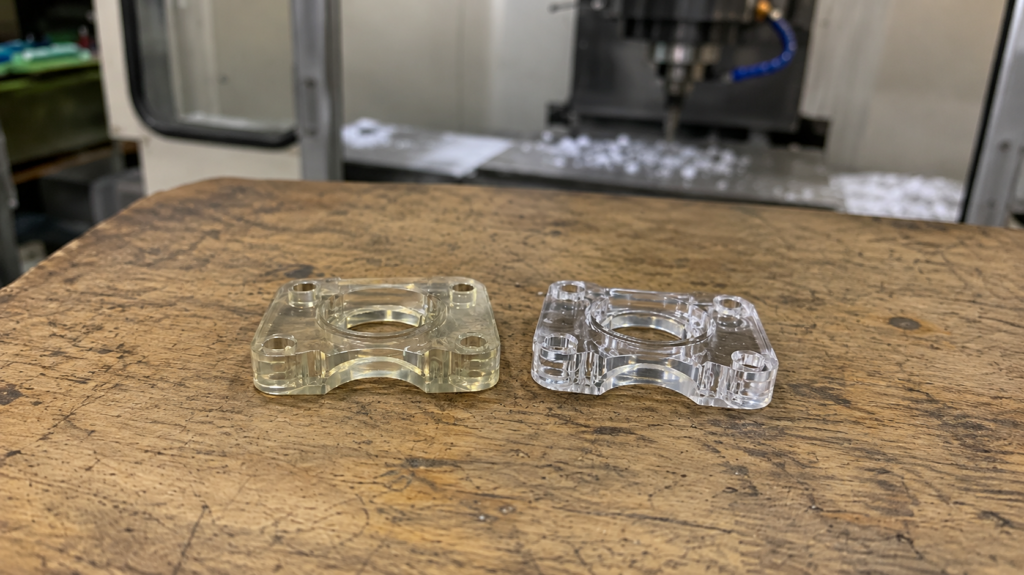
Plastic machining allows polycarbonate optical covers to be produced with precise contours, mounting holes, sealing grooves, and localized thicknesses. Polycarbonate offers high impact resistance and low weight, but its surface scratches easily and may develop haze after repeated cleaning.
A scratch-resistant hard coating can improve durability, but it cannot hide machining defects or remove internal stress. Optical performance depends on the complete process from material selection to final coating inspection.
Start with Optical-Grade Polycarbonate
Not every polycarbonate sheet or billet is suitable for an optical cover. The material should have controlled clarity, low internal contamination, uniform thickness, and sufficient UV stability for the intended environment.
Extruded and molded stock may contain residual stress. Machining can release this stress and cause warping, while incompatible coolants or cleaning solvents may produce crazing around holes and edges.
Material traceability should include the resin grade, manufacturing method, UV additives, thickness, and recommended annealing conditions.
Control Heat During Plastic Machining
Polycarbonate softens when machining heat accumulates. Excessive heat can smear the cut surface, create burrs, distort thin walls, and introduce residual stress.
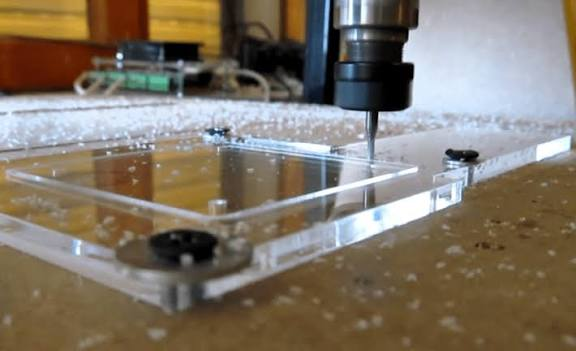
The machining process should use:
- Sharp, polished cutting tools
- Positive cutting geometry
- Stable but moderate feed rates
- Effective chip removal
- Low cutting pressure
- Compatible cooling or air blast
- Rigid, nonmarking workholding
A dull tool rubs instead of cutting and can leave a cloudy edge. Thin optical covers should be supported evenly to prevent vibration and localized deformation.
Protective films may remain on nonmachined areas, but chips must not become trapped beneath the film and scratch the optical surface.
Minimize Stress Around Holes and Edges
Mounting holes, sharp internal corners, and deep pockets concentrate stress. These areas are more likely to crack during coating curing, assembly, temperature cycling, or impact.

Use suitable radii and controlled chamfers rather than sharp transitions. Hole edges should be free of burrs, but aggressive countersinking can create thin, vulnerable sections.
Fasteners should not clamp directly onto unprotected polycarbonate with excessive preload. Washers, compliant seals, or designed metal inserts can distribute assembly pressure.
Annealing may be required after rough or final machining, depending on the material grade and dimensional requirements. The process must be validated because heating can also change part dimensions.
Finish the Surface Before Hard Coating
A transparent hard coating follows the underlying surface. It will not fill deep tool marks, remove waviness, or restore optical clarity to a damaged substrate.
Optical faces should be protected from cutting chips and handling marks. Machined edges may use controlled polishing, but the method must not overheat the polycarbonate.
Flame polishing can produce a clear edge quickly, yet excessive heating may create residual stress. Vapor polishing can improve clarity on suitable surfaces but introduces chemical compatibility, dimensional, and safety concerns.
The final finishing method should be qualified through stress, adhesion, and optical testing.
Choose a Compatible Hard Coating
Common systems for polycarbonate include polysiloxane-based hard coats, UV-cured coatings, and multilayer coatings that combine abrasion resistance with UV or antireflective performance.
The coating system may require:
- Surface cleaning
- Plasma or corona treatment
- Adhesion-promoting primer
- Controlled coating thickness
- Flash-off time
- Thermal or UV curing
A coating that is too hard or too thick may crack when the polycarbonate flexes under impact. A coating that is too soft may provide little improvement over the uncoated surface.
ISO 9211-1 defines terminology and general characteristics used for optical coatings, while ISO 9211-2 covers the specification and representation of their optical properties. ISO 9211-1:2024 ISO 9211-2:2024
Prevent Solvent Damage and Poor Adhesion
Cleaning is critical before coating. Mold release agents, cutting fluids, fingerprints, polishing residue, and airborne silicone can cause craters or delamination.
Strong solvents may attack polycarbonate and initiate stress cracking. Only approved cleaning materials should be used, followed by controlled drying and handling in a clean environment.
Coating should begin within the validated time after surface activation. A long delay can allow the treated surface to lose activation or collect contamination.
Control Coating Thickness and Masking
Although a hard coating is thin, buildup can affect sealing grooves, snap features, threaded inserts, and precision mounting areas. Functional surfaces may require masking.
Uneven coating or curing can also cause optical distortion and part warpage. Coating both sides may help balance stress, but the optical and environmental requirements should determine the final process.
Edges must receive sufficient coverage without forming runs or thick beads.
Verify Optical and Mechanical Performance
Inspection should include more than a visual scratch check. ASTM D1003 provides methods for evaluating haze and luminous transmittance in transparent plastics. ASTM D1003
ASTM D1044 evaluates resistance to surface abrasion by measuring the change in optical properties after abrasion. ASTM D1044
A complete qualification plan should evaluate:
- Initial haze and light transmission
- Coating adhesion
- Abrasion resistance
- Impact resistance
- Optical distortion
- UV and humidity exposure
- Cleaning-chemical resistance
- Thermal cycling
- Edge cracking and delamination
Testing should use finished covers with actual holes, coatings, seals, and mounting conditions.
Conclusion
Durable polycarbonate optical covers require low-stress plastic machining, careful surface preparation, and a flexible but scratch-resistant hard coating. Controlling heat, contamination, coating thickness, curing, and assembly stress preserves both optical clarity and impact resistance.