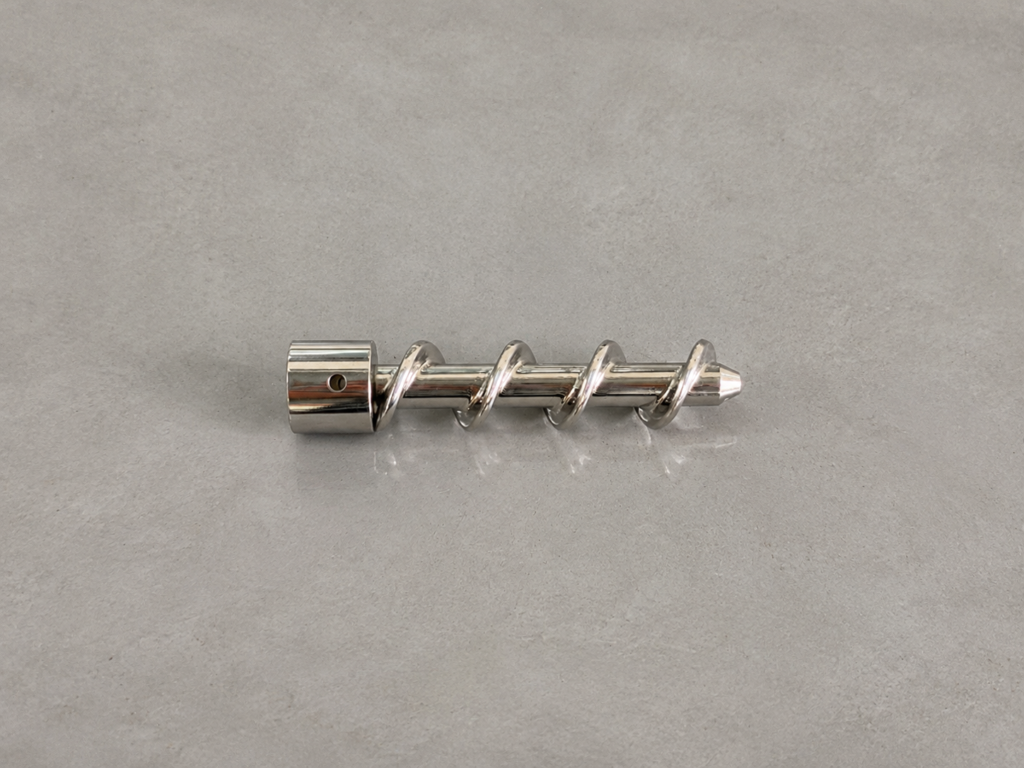

Ball screw surface treatment accuracy noise performance depends on the condition of the rolling tracks, not simply on coating hardness. Heat treatment, grinding, polishing, coatings, and corrosion protection can alter groove geometry, preload, friction, vibration, and long-term positioning stability.
A surface that is extremely hard but uneven may produce more noise and poorer motion than a slightly softer, accurately finished raceway.
Raceway Geometry Determines Positioning Accuracy
Ball screws convert rotary motion into linear displacement through precision contact between the balls, screw groove, and nut groove. Small changes in groove profile can affect:
- Lead accuracy
- Axial clearance
- Preload
- Contact angle
- Friction torque
- Reversal accuracy
ISO 3408-3 specifies acceptance conditions, permissible deviations, and acceptance tests for ball screws. These requirements apply to the finished product, so dimensional verification should be conducted after heat treatment, grinding, coating, and final assembly. ISO 3408-3:2006
A coating applied after final grinding can reduce groove clearance or increase preload. If its thickness varies around the circumference or along the screw, positioning resistance may also vary during travel.
Hardening Improves Wear Resistance but Can Cause Distortion
Induction hardening, carburizing, and nitriding may improve raceway hardness and resistance to contact fatigue. However, heat treatment can introduce distortion, residual stress, or hardness variation.
For precision ball screws, the process sequence commonly places finish grinding after major heat treatment. Grinding corrects heat-treatment distortion and restores the required groove profile and lead accuracy.
The hardened layer must be deep enough to support repeated Hertzian contact stress. A thin or uneven case may crack or deform beneath the rolling track, gradually changing preload and positioning accuracy.
Surface Roughness Influences Friction and Noise
Rough raceways create repeated microscopic impacts as each ball rolls through the contact zone. This increases vibration, friction, temperature, and audible noise.
However, specifying only an Ra value is insufficient. Raceway performance can also be affected by:
- Periodic grinding marks
- Surface waviness
- Pits and pullouts
- Direction of machining marks
- Local burns or soft spots
- Uneven polishing
Periodic waviness may generate a distinct tonal noise related to rotational speed. Random roughness usually produces broader vibration and increases lubricant disturbance.
ISO 21920-1 defines how profile surface-texture requirements are indicated in technical documentation. The drawing should specify appropriate texture parameters and measurement direction for the functional raceway. ISO 21920-1:2021
Coating Thickness Can Change Preload
Electroless nickel, hard chromium, PVD, DLC, and other coatings may be considered for corrosion, wear, or low-friction performance. Their suitability depends on adhesion, thickness uniformity, substrate hardness, and rolling-contact fatigue resistance.
A coating that is only a few micrometres thick can still affect a preloaded ball screw because several coated contact surfaces contribute to the final clearance. Excessive buildup may cause:
- High starting torque
- Temperature rise
- Increased noise
- Premature coating wear
- Reduced positioning repeatability
- Ball recirculation problems
Thick coatings should not be applied directly to a finished precision raceway unless groove dimensions were designed for the coating and the surface is subsequently finished to specification.
Coating Defects Create Local Noise Sources
Poorly bonded coatings may crack, peel, or produce hard debris. Particles circulating through the nut can indent raceways and create recurring vibration each time a ball crosses the damaged area.
Porosity and pinholes can also allow corrosion beneath the coating. Corrosion pits become local impact points, increasing noise and causing torque fluctuation.
When corrosion protection is required, it may be safer to treat exposed non-raceway surfaces while masking the precision rolling tracks. Protective lubricants, sealed nuts, bellows, and environmental control can sometimes provide better accuracy retention than coating the raceway itself.
Lubrication Must Match the Finished Surface
Surface finish and lubricant work as a system. Very rough surfaces disrupt the lubricant film, while excessive polishing may reduce lubricant retention under certain operating conditions.

Grease viscosity, additives, operating speed, load, temperature, and seal drag all influence noise. A low-friction coating cannot compensate for insufficient lubrication or contamination.
Testing should use the actual lubricant and operating orientation because vertical and horizontal installations may distribute grease differently.
Validate the Complete Ball Screw
Inspecting coating thickness or hardness alone cannot confirm performance. Final validation should include:
- Lead and travel deviation
- Axial clearance or preload
- No-load torque consistency
- Temperature rise
- Vibration spectrum
- Sound level at multiple speeds
- Endurance and contamination testing
Noise should be measured across the complete stroke. A single noisy position may indicate local coating buildup, groove damage, waviness, or a recirculation defect.
Conclusion
Ball screw surface treatment must preserve groove geometry, preload, and surface consistency. Controlled hardening followed by precision finishing is often more important than adding a thick coating. When coatings are necessary, dimensional allowance, adhesion, rolling-contact durability, lubrication, and final motion testing must all be qualified together.