
Ultrasonic Cleaning for CNC Parts
Implementing proper ultrasonic cleaning CNC parts protocols is essential before applying surface coatings like anodizing or electroless nickel plating. Standard manual washing often fails, but ultrasonic cleaning CNC parts effectively removes cutting fluids, grease, and micro-swarf from complex geometries and blind holes
Why Ultrasonic Cleaning Is Essential for CNC Parts
During milling and turning, parts are exposed to cutting fluids, rust inhibitors, and particulate contaminants. Manual washing often fails to clean blind holes, internal threads, and deep cavities.
Ultrasonic cleaning utilizes high-frequency sound waves to create microscopic vacuum bubbles in a liquid medium. When these bubbles collapse—a phenomenon known as cavitation—they generate intense scrubbing action that strips away stubborn oils, grease, and micro-swarf without damaging delicate part features.
Step-by-Step Ultrasonic Cleaning Protocol
To achieve a pristine surface ready for coating, follow this standardized ultrasonic cleaning procedure:
Pre-Rinse and Gross Decontamination
Remove loose metal chips and heavy coolant buildup using compressed air or an initial solvent dunk. This extends the bath life of your primary ultrasonic tank.
Main Ultrasonic Wash Bath
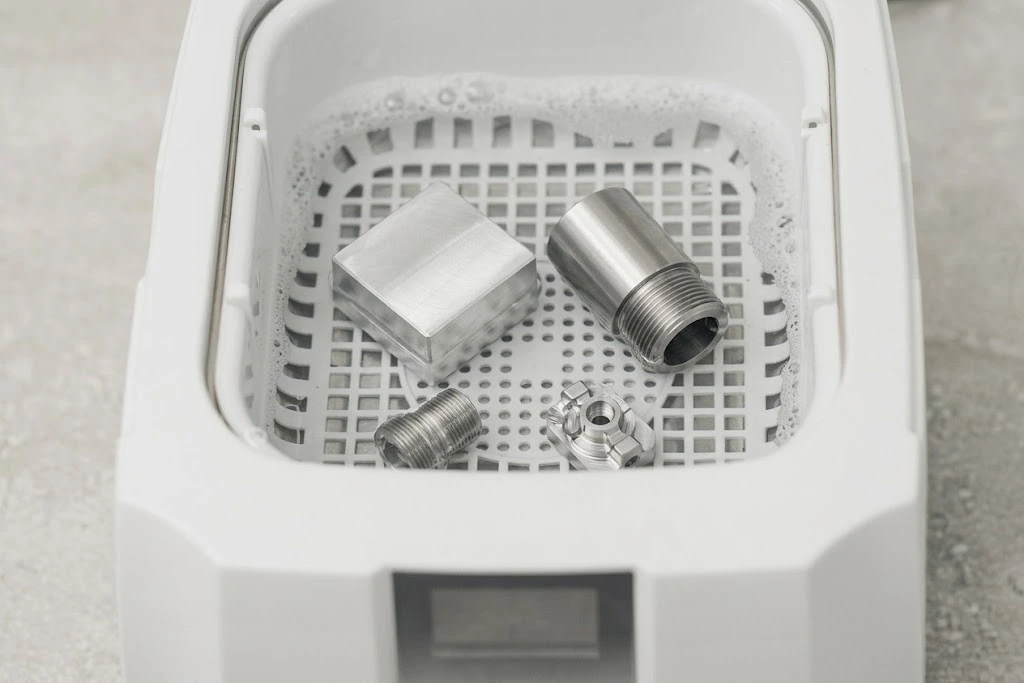
Frequency Selection
Use 37 kHz to 40 kHz for standard aluminum and steel parts. For delicate features or soft metals, use higher frequencies between 80 kHz and 120 kHz.
Chemistry
Choose an aqueous alkaline cleaner for steel and titanium, or a pH-neutral/inhibited formula for aluminum alloys to prevent etching.
Temperature
Maintain liquid temperature between 50°C and 65°C (122°F–149°F) to maximize cavitation efficiency and degreasing speed.
Cycle Time
Ultrasonic immersion typically lasts 3 to 10 minutes depending on part complexity.
Multi-Stage Cascade Rinsing
Rinse parts in clean deionized (DI) or reverse-osmosis (RO) water to prevent detergent residue and spot marks, which can cause blisters or poor adhesion during plating and anodizing.
Controlled Drying
Dry components immediately using hot air dryers or vacuum drying systems to eliminate water spots and prevent flash rusting on carbon steels.
Critical Best Practices for Surface Prep
Avoid Overcrowding
Do not stack parts directly on top of each other. Use custom wire baskets or fixtures to allow cavitational energy to reach all surfaces evenly.
Degas Fresh Baths
Always run new liquid solutions for 5 to 10 minutes before loading parts to purge entrapped gas bubbles that weaken cavitation intensity.
Water Quality
Always use DI water for final rinse steps to avoid mineral deposits on precision tolerances.
By adhering to a structured ultrasonic cleaning protocol, CNC manufacturers can ensure optimal coating adhesion, prevent surface defects, and deliver flawless finished parts.