
Why CNC Parts Warp After Machining
CNC part warping after machining usually occurs when internal stress, cutting heat, or clamping force is released. A component may meet its dimensions while fixed in the machine but bend or twist after removal.
Thin walls, large flat surfaces, deep pockets, and uneven geometries are more likely to deform. Preventing warping requires control of the entire machining process.
Identify the Cause
The time at which deformation appears can help identify the problem.
| When Warping Appears | Likely Cause |
|---|---|
| During rough machining | Internal stress or excessive heat |
| While the part is clamped | High cutting force or weak support |
| Immediately after unclamping | Clamping distortion |
| Several hours later | Gradual stress redistribution |
| After machining one side | Unbalanced material removal |
A part that changes shape immediately after unclamping was often distorted by the fixture. Slower deformation is more likely to be related to residual stress or temperature changes.
Balance Material Removal
Removing too much material from one side can release internal stress unevenly. Rough machining should alternate between opposite surfaces instead of completing one side at a time.
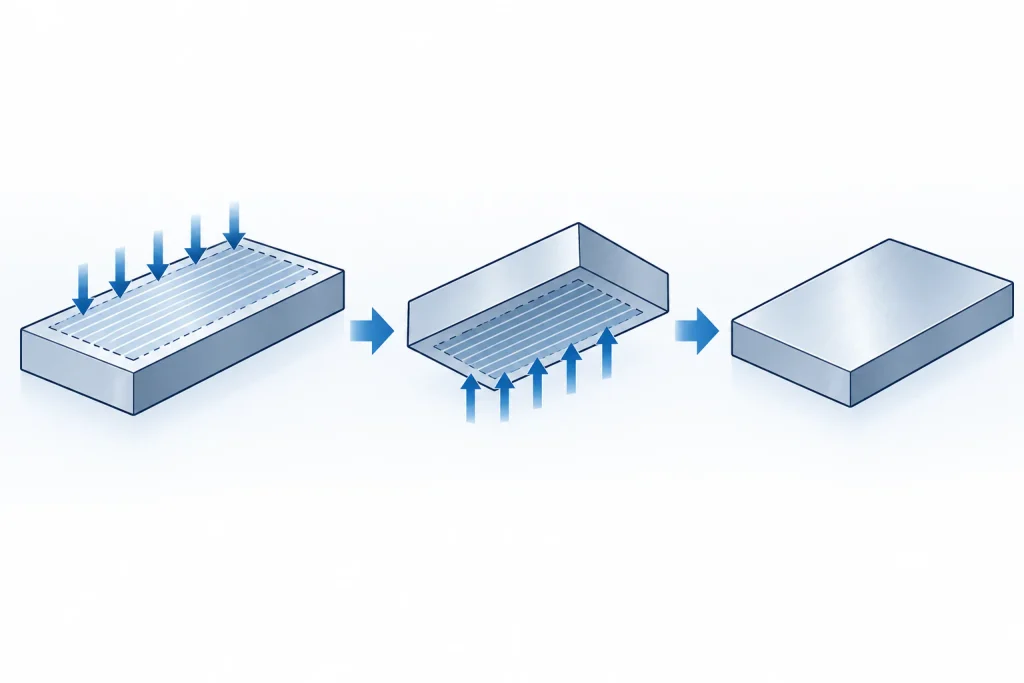
Leave a consistent allowance for semi-finishing and final machining. For deformation-sensitive parts, allow the rough-machined component to rest before continuing so that internal stress can redistribute.
Heavy cuts should be avoided on thin or unsupported areas. Gradual material removal produces a more stable part for the final operation.
Control Clamping and Heat
Excessive clamping force can temporarily bend a workpiece. The machine then cuts the distorted part, which changes shape after the fixture is released.
Use only enough force to hold the part securely. Fixtures should support the component near the cutting area and distribute pressure across stable regions. After rough machining, release and reclamp the part before finishing.
Heat can also cause local expansion. Sharp tools, stable cutting parameters, and effective coolant delivery reduce heat and cutting pressure. Avoid concentrating multiple operations in one small area without allowing the part to cool.
Plan the Finishing Process
Semi-finishing should correct movement caused by rough machining while leaving a small, uniform allowance. Final passes should use stable cutting forces and reliable reference surfaces.
The finished part should reach a stable room temperature before inspection. Large or thin components must also be supported consistently during measurement because their own weight can affect the result.
Conclusion
CNC part warping after machining is commonly caused by residual stress, uneven material removal, excessive clamping, and cutting heat. Balanced roughing, controlled workholding, stable temperatures, and intermediate reclamping can significantly reduce deformation.