
Surface treatment for automotive gears should be selected according to contact stress, tooth-root load, dimensional accuracy, lubrication, and expected failure mode. Carburizing, nitriding, and PVD are not interchangeable: each modifies a different depth of the gear surface and solves a different engineering problem.
Carburizing: The Default for Heavily Loaded Gears
Carburizing introduces carbon into the surface of a low-carbon alloy steel, followed by quenching and tempering. The result is a deep, hard case supported by a tougher core.
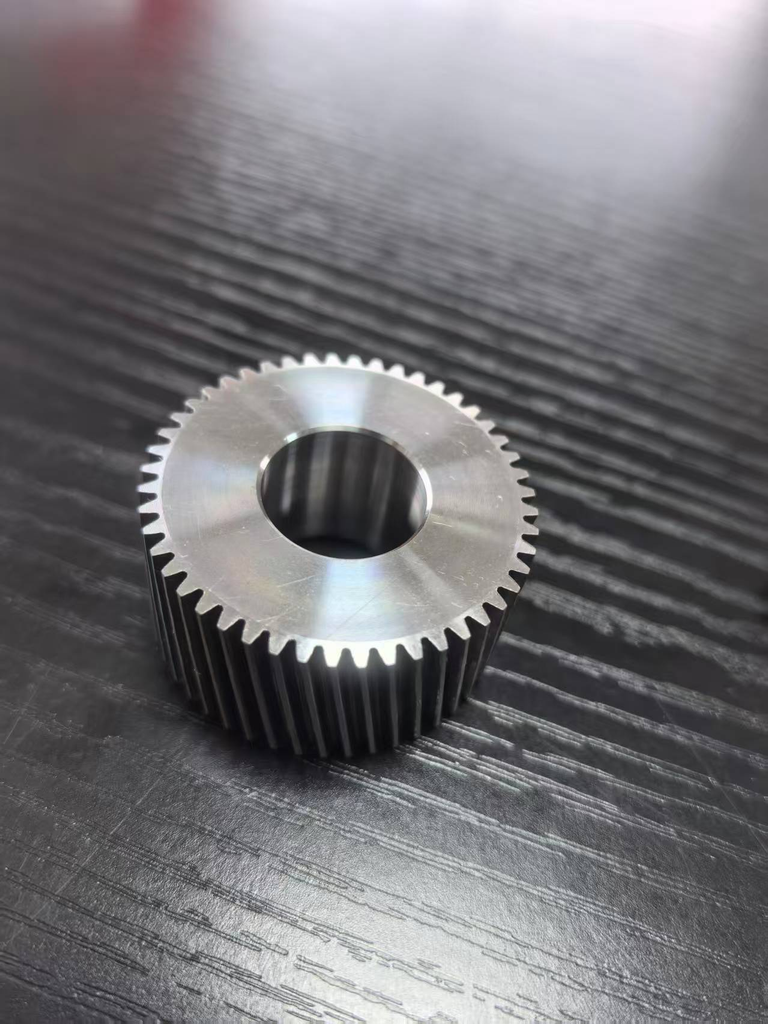
This combination is well suited to transmission gears, differential gears, pinions, and other components exposed to high Hertzian contact stress, impact, and tooth-root bending. The hardened case improves resistance to pitting and rolling-contact fatigue, while the core helps the tooth absorb shock without becoming brittle throughout its section.
Carburizing is usually the strongest choice when load capacity and fatigue life are more important than minimum processing distortion. Its main disadvantage is the high processing and quenching temperature, which can change tooth geometry. Precision gears commonly require controlled heat-treatment fixtures, stock allowance, post-treatment grinding, and inspection for grinding burn.
The finished case depth is a design parameter rather than a fixed value. ISO 18203:2026 specifies methods for measuring case-hardening and nitriding-hardness depths. Case depth must match gear module, tooth geometry, load distribution, and allowable core stress.
Nitriding: Better Dimensional Stability
Nitriding diffuses nitrogen into an already hardened and tempered alloy steel. Because the process normally operates below the steel’s transformation temperature and does not require quenching, dimensional change is generally lower than with carburizing.
It is attractive for precision gears, timing components, actuator gears, and limited-production parts where tooth geometry must be retained after final machining. The nitrided surface offers high hardness, compressive residual stress, and good resistance to adhesive wear and scuffing.
The limitation is depth. A nitrided case is generally shallower than a carburized case and depends strongly on alloy composition. Steels containing suitable nitride-forming elements provide better results; ISO 683-5 covers technical delivery requirements for nitriding steels.
Nitriding is therefore most suitable when distortion control and surface wear resistance dominate. For large gears exposed to severe impact or very high subsurface stress, a shallow nitrided layer may not provide the same load-bearing reserve as a properly designed carburized case.
PVD: A Thin Functional Layer, Not a Deep Case
PVD deposits a very thin hard coating such as CrN, TiN, or a carbon-based layer onto the finished gear. It can reduce friction, improve scuffing resistance, limit adhesive wear, and protect the surface during marginal lubrication.
The coating does not create a deep load-bearing zone. If the steel beneath it is too soft or deforms under contact pressure, the PVD layer can crack or detach. PVD should therefore not be treated as a direct replacement for carburizing or nitriding on highly loaded automotive gears.
Its strongest application is often a duplex system: a carburized or nitrided substrate supplies case depth and fatigue strength, while the PVD layer improves friction and surface wear behavior. ISO 21874 addresses evaluation of the composition, structure, and properties of multilayer PVD hard coatings.
Surface finish, edge geometry, residual grinding damage, cleaning, adhesion layers, and coating temperature must all be controlled. A hard coating applied over a defective tooth flank will not correct the underlying problem.
Match the Process to the Failure Mode
Choose carburizing when the gear must carry high contact and bending loads with a deep supporting case. Choose nitriding when dimensional stability, surface hardness, and low post-treatment correction are priorities. Consider PVD when friction, scuffing, or lubricant-film breakdown is the main concern and the substrate already has sufficient strength.
The decision should also account for pitting, micropitting, tooth-root fatigue, scuffing, abrasive contamination, noise, efficiency, and manufacturing cost. ISO 6336-2 provides calculation principles for gear surface durability, but separate evaluation is required for damage modes such as scuffing and scratching.
Validate the Complete Manufacturing Route
Testing should use finished gears rather than coating coupons alone. Verification should include case-depth and hardness profiles, microstructure, residual stress, dimensional change, tooth-flank roughness, coating adhesion, and gear fatigue testing under representative lubricant and temperature conditions.
For PVD-coated gears, testing must continue until the coating has worn or stabilized. A short test may measure only the coating’s initial behavior rather than the long-term performance of the complete surface system.
Conclusion
Carburizing remains the primary option for heavily loaded automotive gears. Nitriding is valuable where precision and low distortion matter, while PVD is best used as a thin tribological layer over a properly supported substrate. The correct choice comes from the gear’s load, failure mode, material, and manufacturing route—not surface hardness alone.