CNC Machining Tolerance Design Guidelines
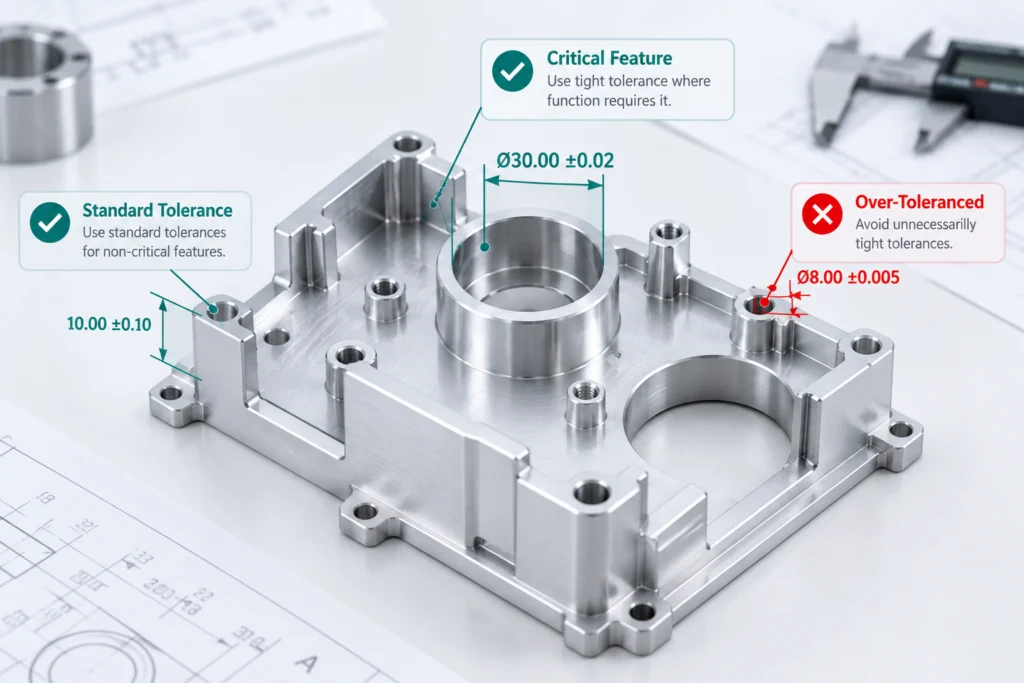
Apply tighter tolerances only where function requires them to improve part performance while controlling machining and inspection costs.
Get a Quote
CNC machining tolerance design showing standard, critical, and over-toleranced dimensions
TOLERANCE DESIGN BASICS

Apply Tolerances Where They Matter Most

Reserve tighter tolerances for functional features and use standard tolerances on non-critical dimensions to improve manufacturability and control costs.
Feature
Recommended
Avoid
Notes
Critical Dimensions
Apply tighter tolerances where function requires them
Tight tolerances on every dimension
Focus precision on mating, sealing, alignment, and other critical features
Non-Critical Dimensions
Use standard machining tolerances
Unnecessarily tight specifications
Wider tolerances reduce machining and inspection effort
Hole Diameters
Specify fit-based tolerances when required
Tight tolerance without functional need
Consider clearance, transition, or press-fit requirements
Flatness & Parallelism
Control only functional surfaces
Tight GD&T across all surfaces
Geometric controls can significantly affect machining cost
Tolerance Stack-Up
Evaluate interacting dimensions together
Independent tight tolerances everywhere
Stack-up analysis helps protect assembly function
Inspection Requirements
Define measurable, functional requirements
Difficult or unnecessary inspection criteria
Complex inspection can add lead time and cost
Design Tip: Tight tolerances should be driven by function, fit, and assembly requirements—not applied uniformly across the entire part.
TOLERANCE & INSPECTION

CNC Tolerance & Inspection Considerations
Functional Requirements
Apply tight tolerances only to dimensions that directly affect fit, alignment, sealing, or performance.
Process Capability
Tighter tolerances require stable tooling, rigid setups, and controlled machining conditions.
Material Stability
Thin walls, heat, and residual stress can affect dimensional accuracy after machining.
Datum & Setup
Clear datum references help maintain consistent relationships between critical features.
Inspection Requirements
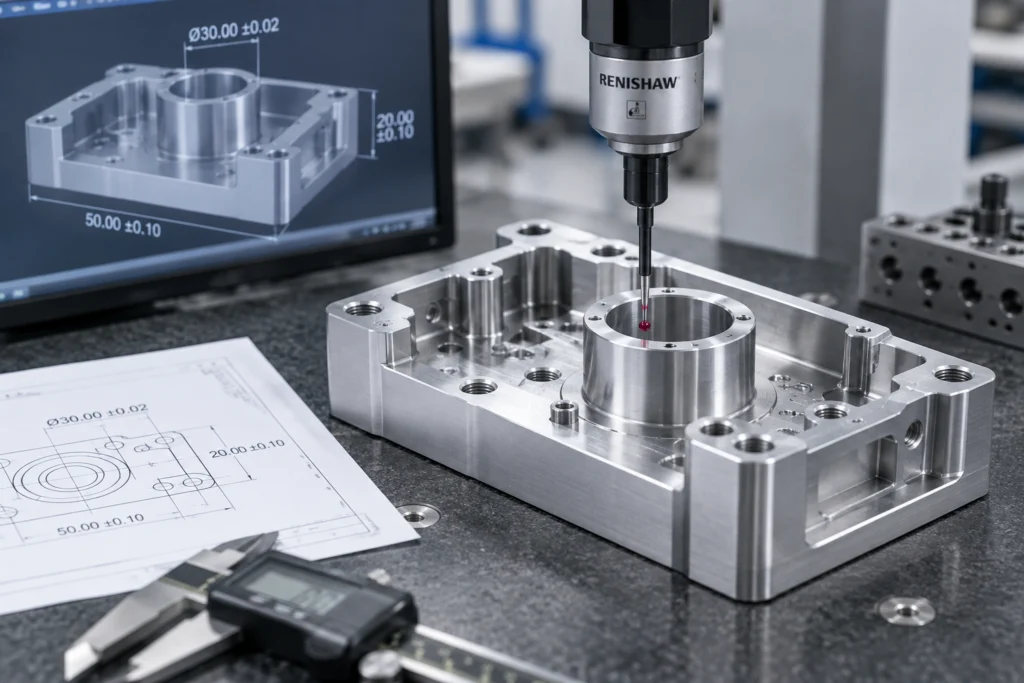
Very tight tolerances often require additional measurement steps, increasing cost and lead time.
CMM inspection of a precision CNC machined part with dimensional tolerances
DESIGN EXAMPLES

Good vs. Poor Tolerance Design

Compare recommended and poor tolerance strategies for better function, manufacturability, inspection efficiency, and cost control.
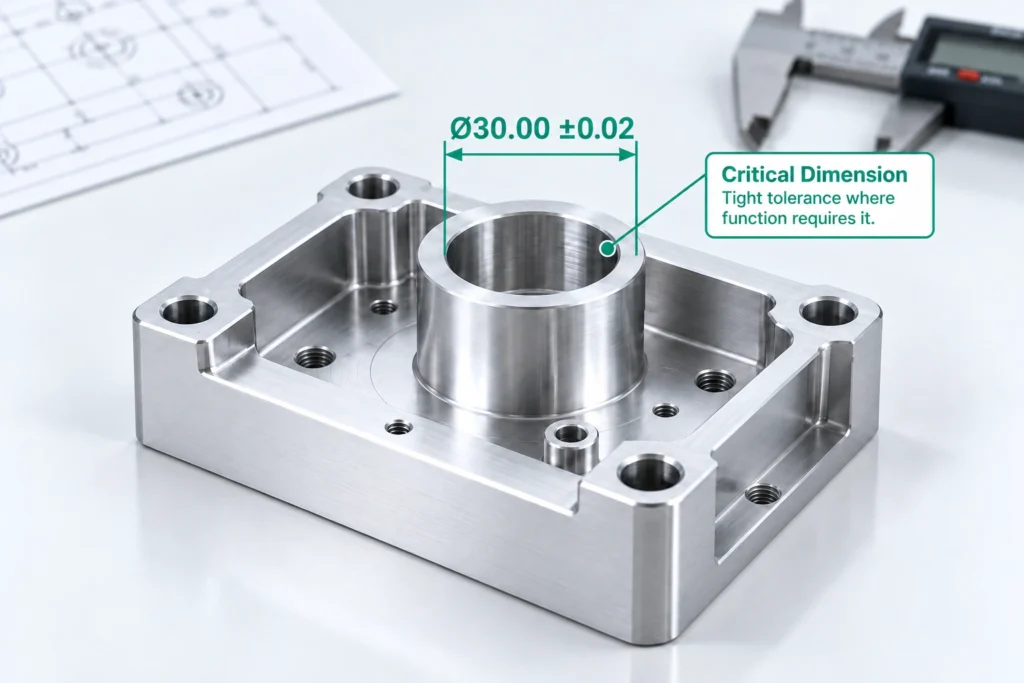
Functional tolerances applied to critical dimensions on a CNC machined part

Functional Tolerances

Apply tight tolerances only to dimensions that directly affect fit, alignment, sealing, or performance.
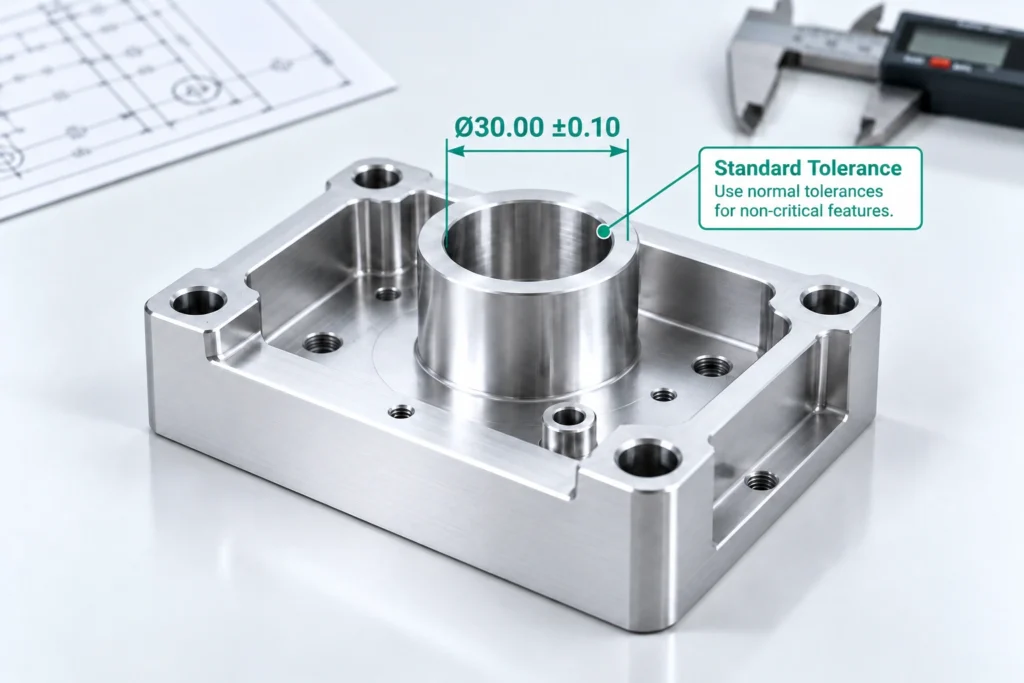
Standard machining tolerances applied to non-critical CNC part dimensions

Standard Tolerances

Use standard machining tolerances on non-critical dimensions whenever possible.
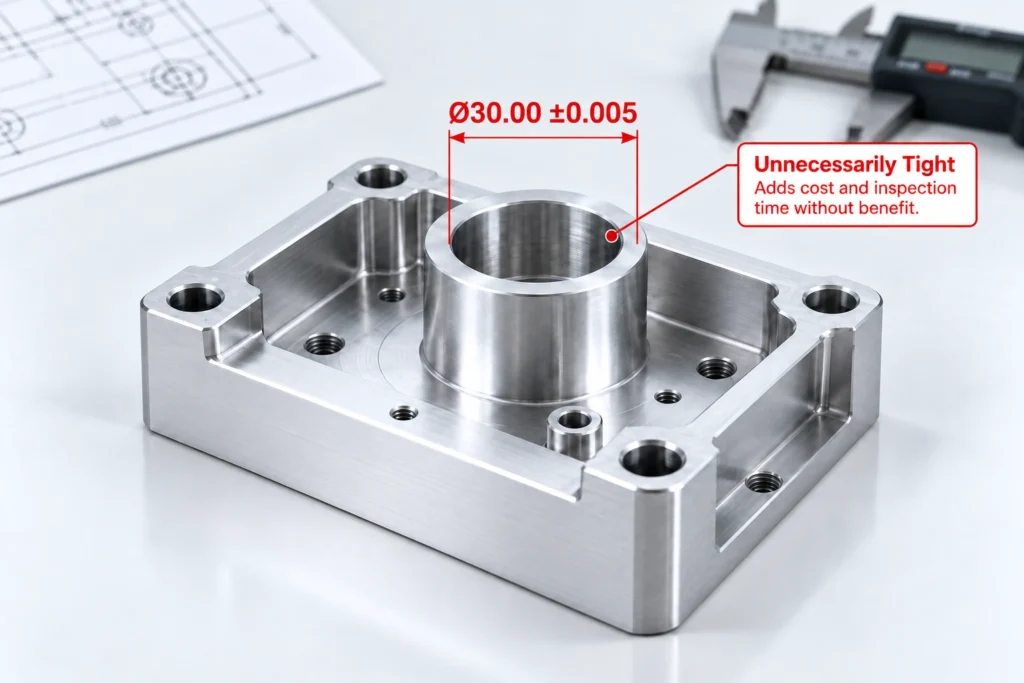
Example of unnecessarily tight tolerances increasing CNC machining complexity

Unnecessarily Tight Tolerances

Avoid specifying tighter tolerances than the function requires, as this increases machining and inspection costs.
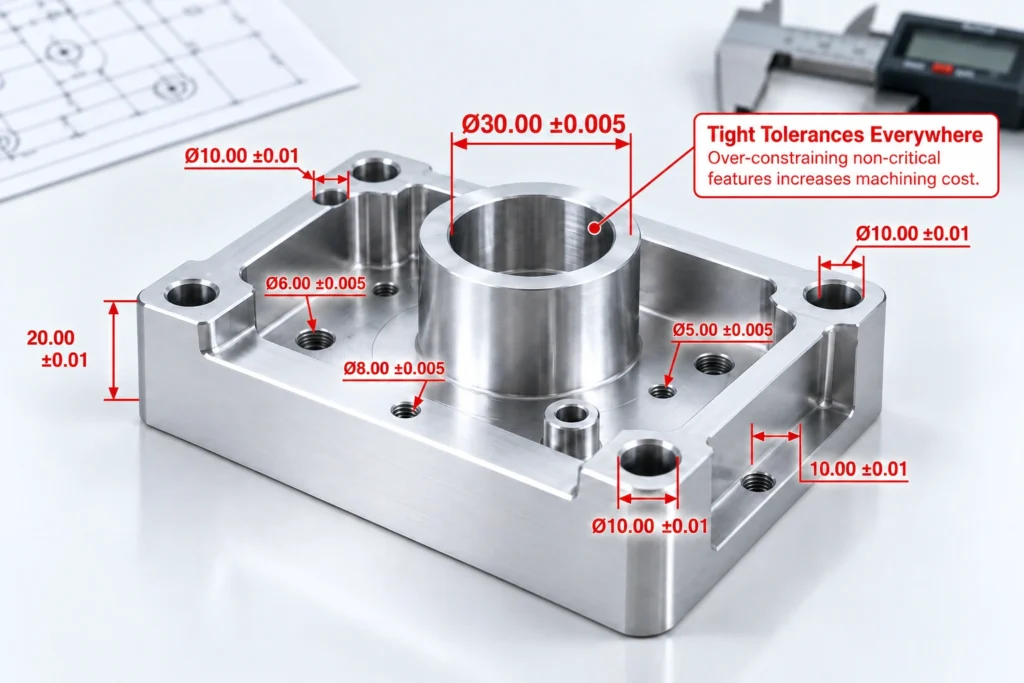
CNC machined part with excessive tight tolerances specified on multiple dimensions

Tight Tolerances Everywhere

Applying tight tolerances to every dimension adds complexity and cost without improving part function.

Need a Tolerance Design Review?

Send us your drawings or CAD files for a DFM review. We can assess critical dimensions, tolerance requirements, datum strategy, GD&T, and inspection needs before production.
FAQ

Tolerance Design FAQs

Common questions about CNC machining tolerances, dimensional accuracy, GD&T, and inspection requirements.

Tolerances should be based on the functional requirements of the part. Standard machining tolerances are suitable for many features, while tighter tolerances should be reserved for critical fits, alignment, sealing, or performance-related dimensions.

Yes. Tighter tolerances can require more precise tooling, additional machining passes, slower cutting conditions, more frequent inspection, and tighter process control, all of which can increase cost and lead time.

No. Tight tolerances should only be applied where they are functionally necessary. Using standard tolerances on non-critical dimensions improves manufacturability and helps control machining and inspection costs.

Material stability, wall thickness, feature size, part rigidity, heat, and residual stress can all influence achievable accuracy. Thin or flexible features generally require more careful tolerance planning.

GD&T is useful when the functional relationship between features is more important than an individual size dimension. Position, flatness, parallelism, perpendicularity, and runout can provide clearer functional requirements for machining and inspection.