5-Axis CNC Machining Design Guidelines

Design complex parts for better tool access, fewer setups, shorter tool reach, and greater machining stability.
Get a Quote
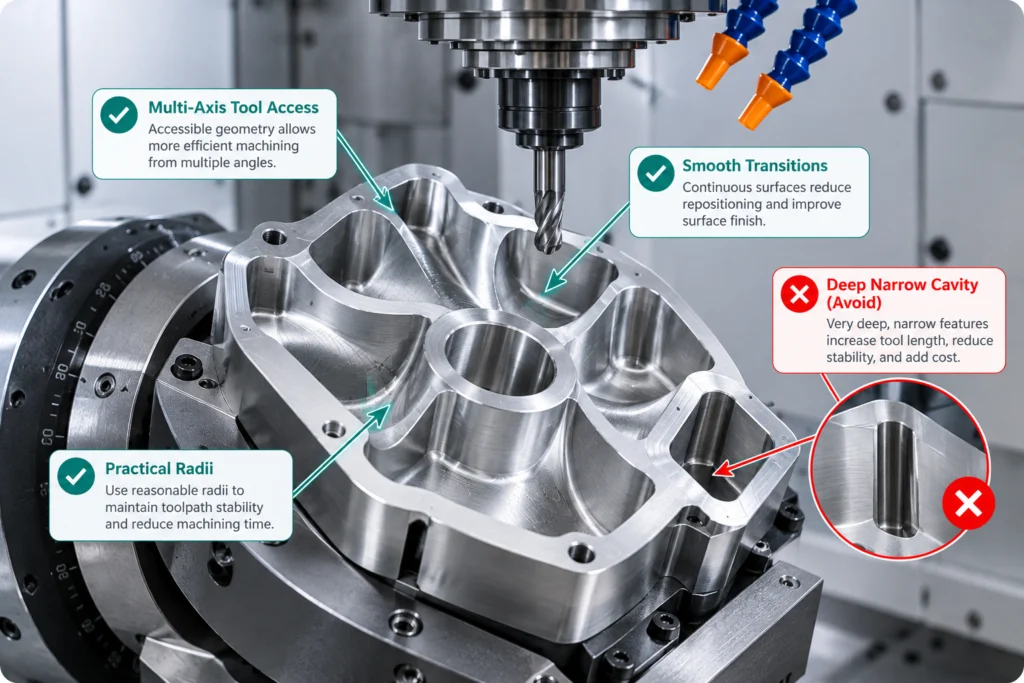
5-axis CNC machining design guidelines showing tool access, practical radii, and deep cavity considerations
5-AXIS DESIGN BASICS

Design Parts for Efficient 5-Axis Machining

Design features that remain accessible from practical tool angles to reduce repositioning, long-tool use, and unnecessary machining complexity.
Feature
Recommended
Avoid
Notes
Tool Access
Keep critical features accessible from practical tool angles
Deep or hidden features blocked by surrounding geometry
Better access allows shorter, more rigid tools
Part Orientation
Design features to minimize part reorientation
Features requiring excessive repositioning
Fewer orientations reduce setup time and accumulated error
Deep Features
Use practical depths with adequate cutter clearance
Deep, narrow cavities
Deep features may require longer tools and reduce machining stability
Undercuts
Use standard, accessible undercut geometry
Complex or hidden undercuts
Non-standard undercuts may require special tooling
Complex Surfaces
Use smooth, continuous geometry where possible
Abrupt transitions and difficult tool paths
Smooth geometry improves toolpath stability and surface quality
Workholding Access
Leave sufficient areas for secure clamping
Geometry that restricts fixture access
Stable workholding helps maintain dimensional consistency
Design Tip: Prioritize clear tool access, practical feature depth, and secure workholding. These choices can reduce setups, tool reach, machining time, and dimensional variation.
5-AXIS MACHINING

5-Axis Machining Design Considerations
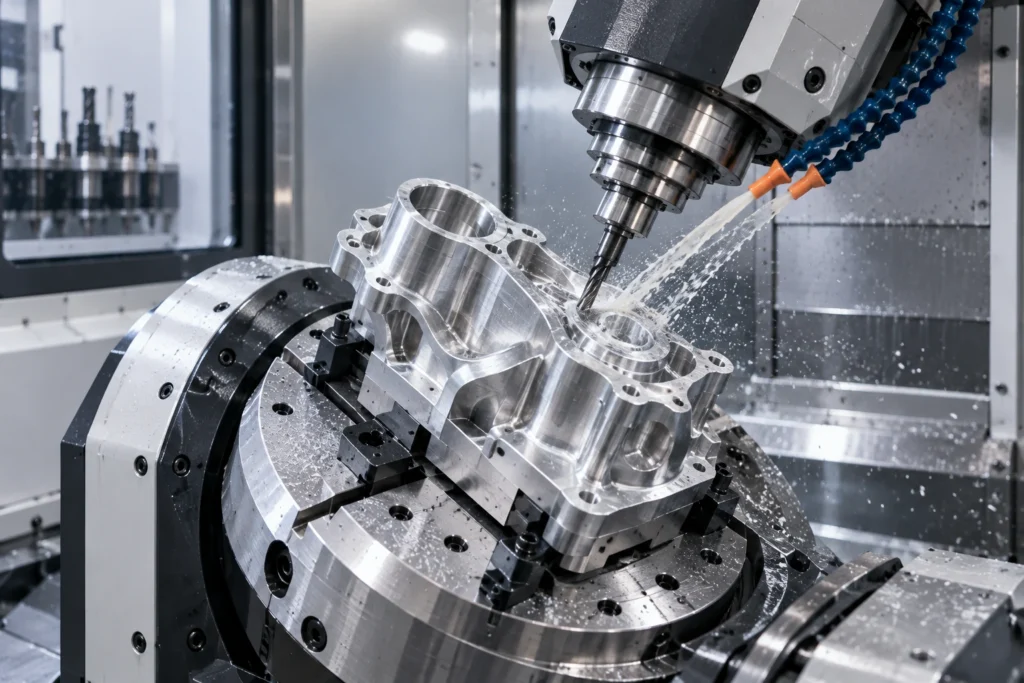
Tool Orientation
Allow practical tool angles so cutters can reach complex surfaces without excessive tilting or repositioning.
Tool Reach
Keep critical features within practical tool reach. Shorter, more rigid tools improve stability and surface quality.
Part Geometry
Use smooth transitions and open geometry to support stable multi-axis toolpaths.
Workholding
Provide sufficient clamping areas so the part can be held securely while multiple faces are machined.
Collision Clearance
Avoid geometry that may cause interference between the cutter, holder, spindle, fixture, or workpiece.
5-axis CNC machining an aluminum part with multi-angle tool access and complex geometry
DESIGN EXAMPLES

Good vs. Poor 5-Axis Machining Design
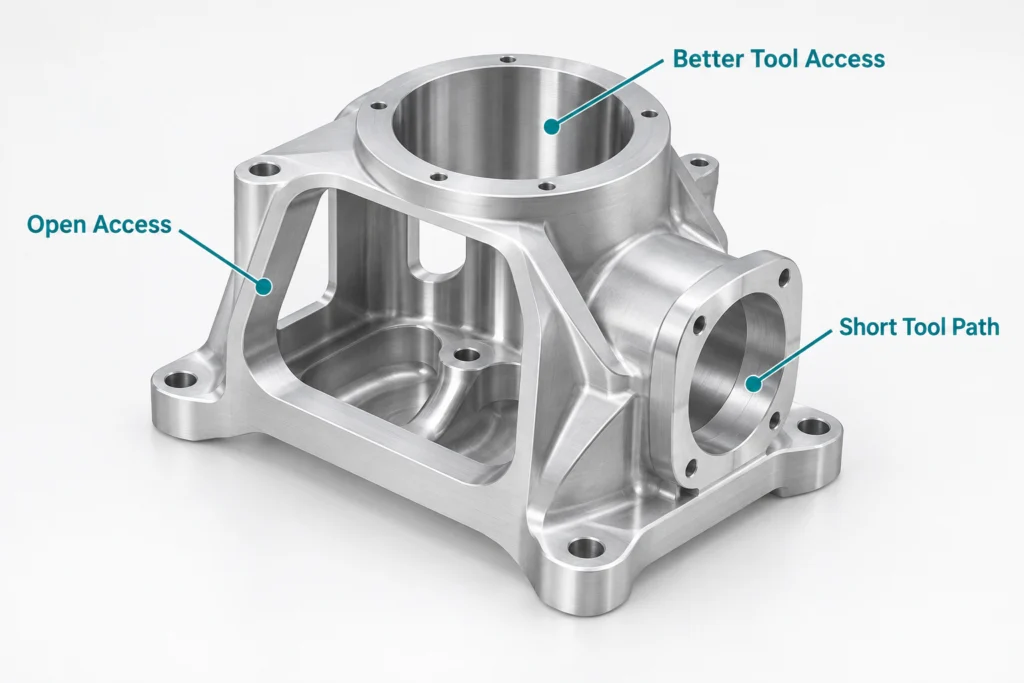
Compare design choices that improve tool access, machining stability, setup efficiency, and overall 5-axis manufacturability.
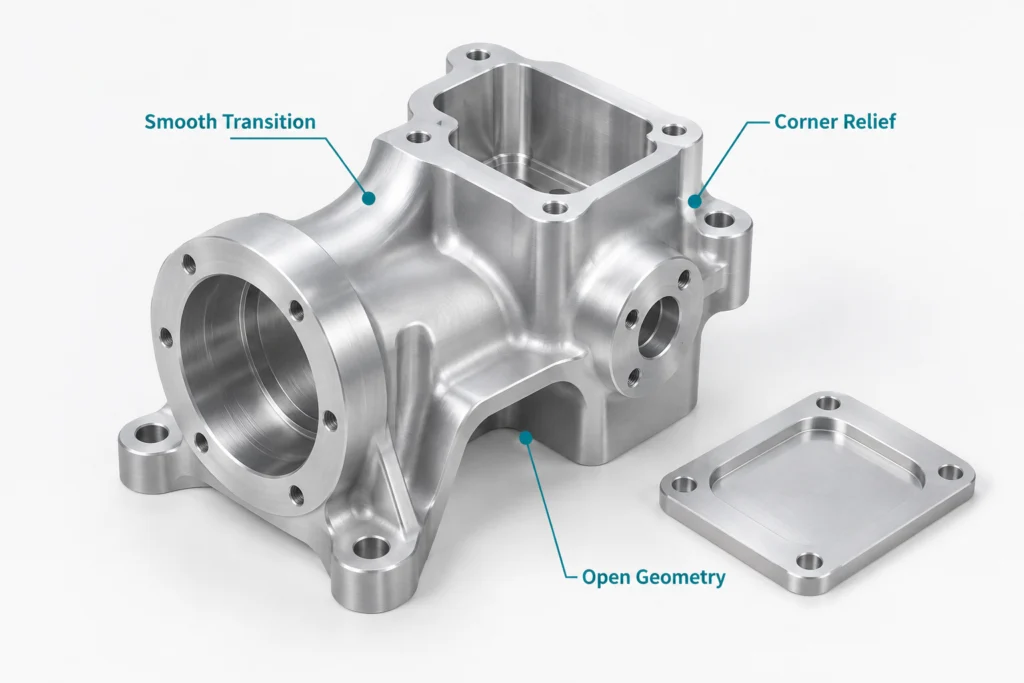
5-axis machined part designed with clear multi-axis tool access and short tool paths

Clear Multi-Axis Tool Access

Keep critical features accessible from practical tool angles to reduce long-tool use and repositioning.
5-axis machined part with smooth continuous geometry for stable multi-axis toolpaths

Smooth Continuous Geometry

Use smooth transitions and open geometry to support stable multi-axis toolpaths and consistent surface quality.
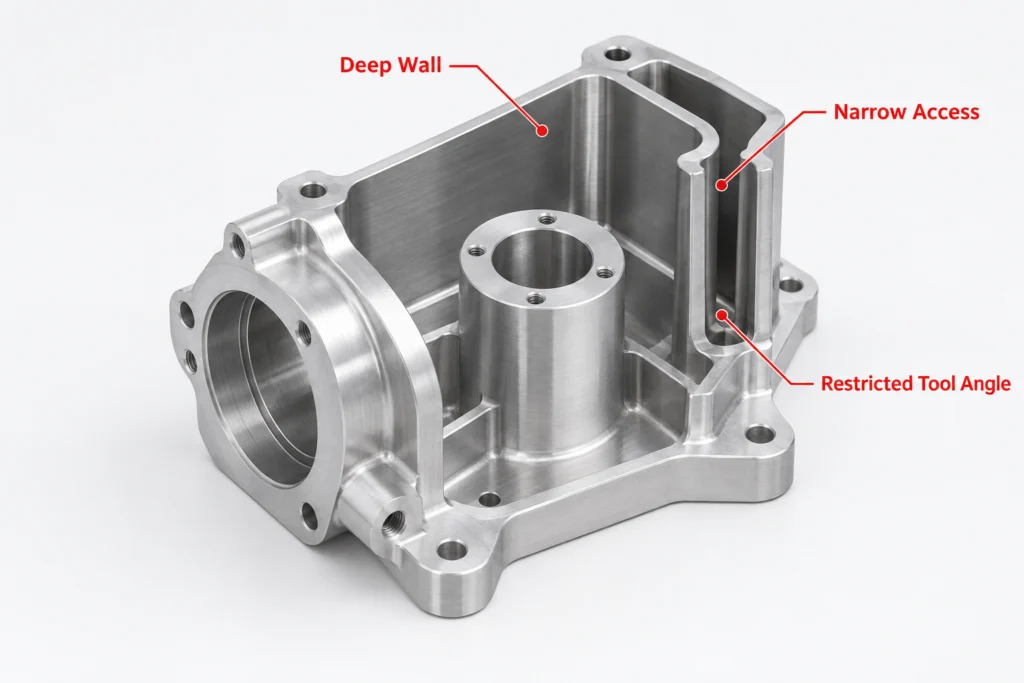
5-axis machining design with restricted tool access caused by deep walls and narrow geometry

Restricted Tool Access

Deep walls and surrounding geometry can block the cutter or holder, requiring longer tools or additional setups.
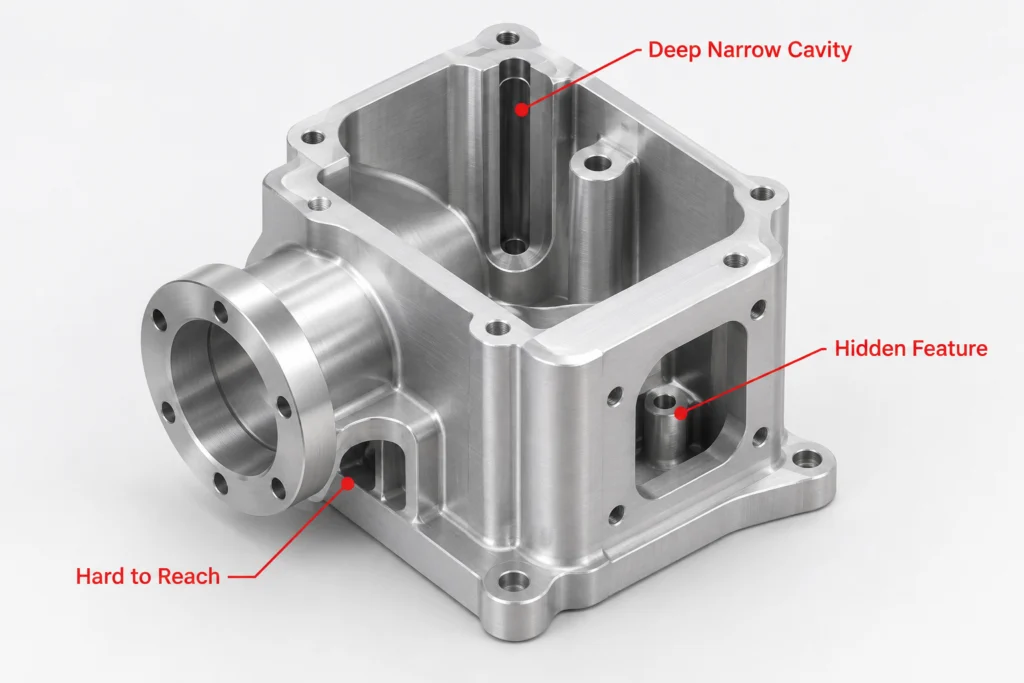
5-axis machined part with hidden features and deep cavities that increase machining difficulty

Complex Hidden Features

Hidden undercuts and difficult-to-reach cavities increase tooling complexity, collision risk, and machining time.

Need a 5-Axis Machining Design Review?

Send us your drawings or CAD files for a DFM review. We can assess tool access, feature depth, workholding, collision risks, and overall 5-axis machinability before production.
FAQ

5-Axis Machining FAQs

Common questions about 5-axis tool access, part geometry, setup reduction, workholding, and machining accuracy.

5-axis machining is well suited to complex parts with angled features, curved surfaces, deep cavities, or features on multiple faces that would otherwise require several setups.

The machine can tilt or rotate the part or cutting tool to reach multiple faces in one setup, reducing repositioning, fixture changes, and accumulated setup error.

No. Some complex parts can be produced efficiently with 3-axis or 4-axis machining. The best process depends on geometry, tolerances, tool access, quantity, and cost.

Avoid deep narrow cavities, hidden undercuts, and geometry that blocks the cutter or holder. Open access and practical feature depth allow shorter, more rigid tools.

It can. Fewer setups reduce repositioning error, while shorter tools and better access can improve rigidity, surface quality, and dimensional consistency.