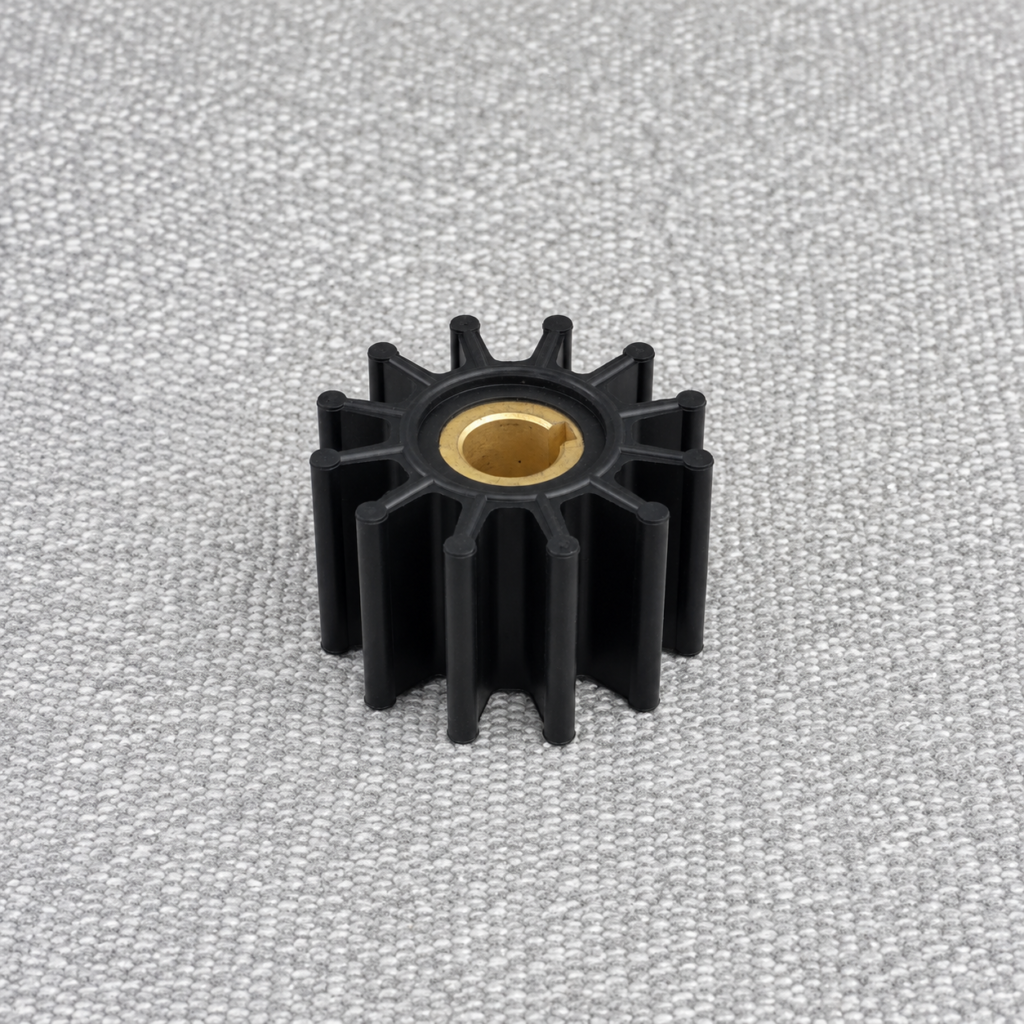
A nickel aluminum bronze impeller operates in an unusually aggressive environment. During every rotation, its blades contact chloride-rich water, experience rapid pressure changes, and carry repeated mechanical loads. Suspended sand and collapsing bubbles may also strike the blade surfaces.
The First Contact: Chloride-Rich Seawater
Ordinary carbon steel can corrode quickly in seawater, while some stainless steels may suffer pitting or crevice corrosion when oxygen levels, flow conditions, and surface cleanliness are unfavorable.
Nickel aluminum bronze develops a protective surface film that slows further corrosion. Aluminum contributes to this film, while nickel and iron improve the alloy’s strength and help stabilize its microstructure.
This does not make the material immune to corrosion. Its advantage is that it provides a practical balance of corrosion resistance and mechanical performance in continuously operating marine pumps.
At the Blade Edge: Fast Flow and Suspended Particles
The outer edge of an impeller moves much faster than the water near its hub. This creates high local velocity and exposes the leading edges to erosion-corrosion.
Nickel aluminum bronze has better resistance to impingement and flowing seawater than many conventional copper alloys. Its relatively high strength also helps the blades retain their profile when the pumped water contains small amounts of sand or other particles.
Blade geometry remains important. Poor inlet conditions, excessive velocity, or direct particle impact can damage even a correctly specified alloy.
Where Pressure Drops: Cavitation Begins
Pressure may fall sharply as water enters the impeller. If it falls too low, vapor bubbles form and then collapse against the blade surface. Each collapse produces a small impact. Repeated thousands of times, these impacts can create pits and gradually remove material.
A nickel aluminum bronze impeller combines toughness, strength, and useful resistance to cavitation erosion. It therefore tolerates these repeated impacts better than softer marine alloys.
Material selection alone cannot solve severe cavitation. Pump speed, inlet pressure, impeller geometry, surface finish, and operating point must also be controlled.
At the Hub: Repeated Loads Never Stop
The hub transfers motor torque to the blades, while every blade experiences changing hydraulic forces. The material must resist distortion and fatigue without becoming excessively brittle.
C95800 castings have substantially higher strength than traditional tin bronzes and gunmetals. This allows designers to produce comparatively thin, efficient blades while maintaining structural reliability.
The alloy also offers good resistance to galling, which is useful around wear rings and other closely fitted pump components.
Before Rotation: Casting and Machining Matter
Complex curved blades are difficult to produce economically from solid stock. Nickel aluminum bronze is suitable for casting, allowing the basic impeller geometry to be formed before critical surfaces are machined.
Final machining must control the hub bore, blade profile, runout, and balance. Uneven blade thickness or an off-center bore can create vibration, increasing bearing loads and accelerating cavitation damage.
Casting quality is equally important. Porosity, inclusions, unsuitable weld repairs, or an incorrect heat-treatment cycle may reduce corrosion resistance and create early failure points.
When Nickel Aluminum Bronze Can Still Fail
Long periods in stagnant, polluted seawater can produce localized attack, especially when sulfides are present. Improper microstructure may also increase the risk of selective phase corrosion. For this reason, alloy certification and the specified heat treatment should be verified rather than relying only on the material name.
Galvanic design must also be considered when the impeller operates beside stainless steel or other dissimilar metals. The exposed area ratio and electrical connection can influence which component corrodes.
A Balanced Marine Material
Nickel aluminum bronze is used for seawater pump impellers because it addresses several problems at once: corrosion, cavitation, erosion, repeated loading, and complex manufacturing.
Its performance still depends on correct casting, heat treatment, machining, and pump design. When these factors are controlled, a nickel aluminum bronze impeller can provide reliable service without requiring the cost of more highly alloyed materials.