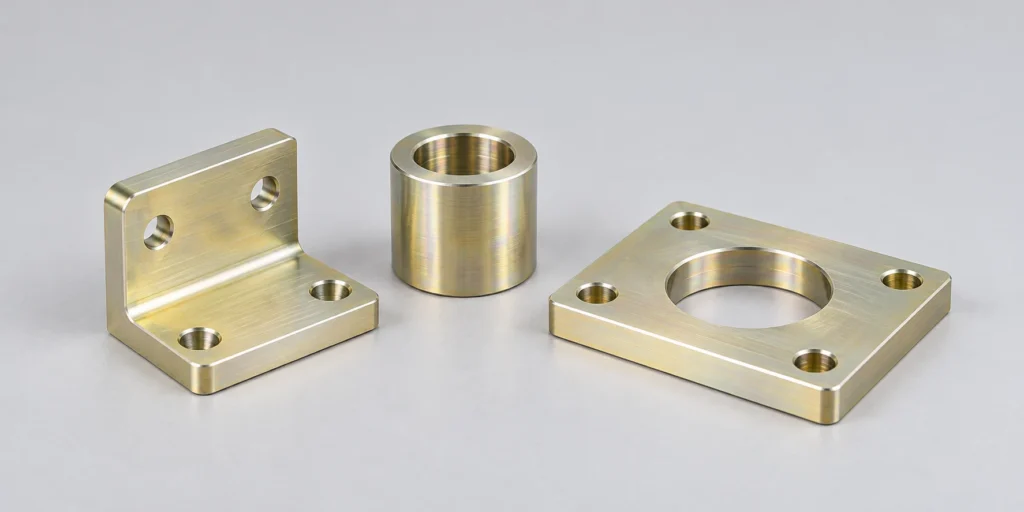
Chromate conversion coating is a chemical surface treatment that protects aluminum CNC parts from corrosion while improving paint adhesion and electrical performance. Because the resulting film is very thin, it has little effect on part dimensions and is suitable for precision components.
What Is Chromate Conversion Coating?
Chromate conversion coating forms a protective film through a chemical reaction with the aluminum surface. It is also known as chemical conversion coating or chromating. Alodine is another commonly used term, although it is a commercial product name.
Unlike electroplating, this process does not deposit a separate metal layer. The aluminum surface itself is chemically converted into a protective film.
The film is much thinner than an anodized coating. It can therefore be applied to precision holes, threads, mating surfaces, and other features with tight tolerances.
Main Benefits
The primary purpose of chromate conversion coating is to improve corrosion resistance. The film helps protect aluminum against oxidation, staining, and environmental exposure.
It is also widely used as a pretreatment before painting. The converted surface improves the adhesion of primers and paints, reducing the risk of peeling, blistering, and corrosion beneath the paint.
Another important benefit is electrical performance. Anodizing normally creates an insulating surface, while a thin conversion coating can retain better electrical contact. This makes it suitable for electronic enclosures, grounding areas, mounting plates, and communication equipment.
Types and Classes
Under MIL-DTL-5541, conversion coatings are divided into Type I and Type II.
Type I contains hexavalent chromium and is known for strong corrosion protection. Type II contains no hexavalent chromium and is commonly selected when environmental or restricted-substance requirements apply.
The standard also includes Class 1A and Class 3. Class 1A is mainly used for corrosion protection and paint adhesion. Class 3 is intended for parts that require lower electrical contact resistance.
Because Class 3 coatings are generally thinner, they may provide less corrosion protection than Class 1A. The appropriate type and class should be selected according to the function and operating environment of the part.
Chromate Conversion Coating Process
The aluminum part is first cleaned to remove machining oil, coolant, fingerprints, and other contaminants. It may then be lightly etched and deoxidized to prepare a clean and active surface.
The conversion solution is applied by immersion, spraying, or brushing. Treatment time, solution concentration, temperature, and pH influence the quality of the film.
After treatment, the part is rinsed and dried under controlled conditions. The finished surface can then be inspected for appearance, coating coverage, corrosion resistance, electrical performance, and dimensions.

Chromate Conversion Coating vs Anodizing
Anodizing creates a thicker and harder oxide layer. It normally provides better wear resistance and offers more decorative color options, but it also has a greater effect on part dimensions and produces an electrically insulating surface.
Chromate conversion coating is much thinner. It is generally more suitable for electrical contact, paint pretreatment, threads, precision holes, and tight-tolerance CNC parts.
Anodizing is usually preferred when hardness, wear resistance, or decorative appearance is the main requirement. Conversion coating is preferred when conductivity, paint adhesion, or minimal dimensional change is more important.
Applications and Specification
Chromate conversion coating is commonly used for aerospace components, electronic enclosures, grounding parts, communication equipment, automotive components, mounting plates, and aluminum parts that will be painted.
A technical drawing should specify the applicable standard, coating type, performance class, restricted-substance requirements, and any areas that must be masked.
For example:
“Chemical conversion coating per MIL-DTL-5541, Type II, Class 3. Hexavalent-chromium-free.”
The final specification should always match the part’s operating environment, electrical requirements, dimensional tolerances, and customer documentation.
Conclusion
Chromate conversion coating provides corrosion protection, improves paint adhesion, and can retain better electrical contact than anodizing. Its thin film also makes it suitable for precision aluminum CNC parts.
Class 1A is normally selected for corrosion protection and paint preparation, while Class 3 is used when lower electrical resistance is required. Type I contains hexavalent chromium, whereas Type II uses hexavalent-chromium-free materials.