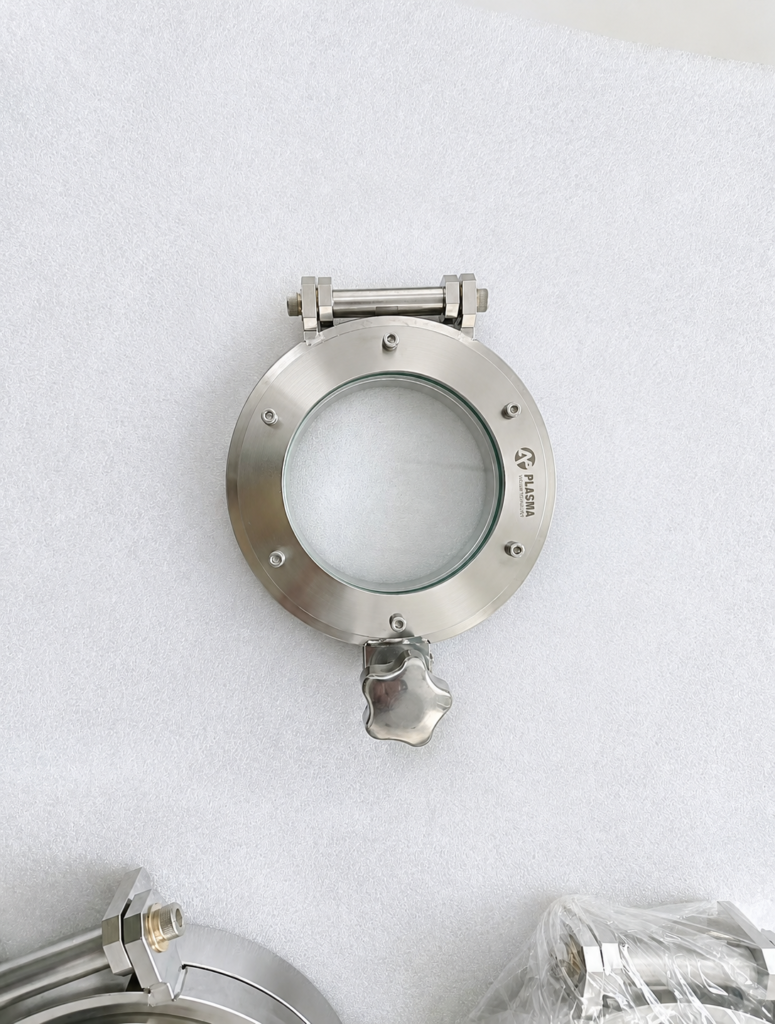
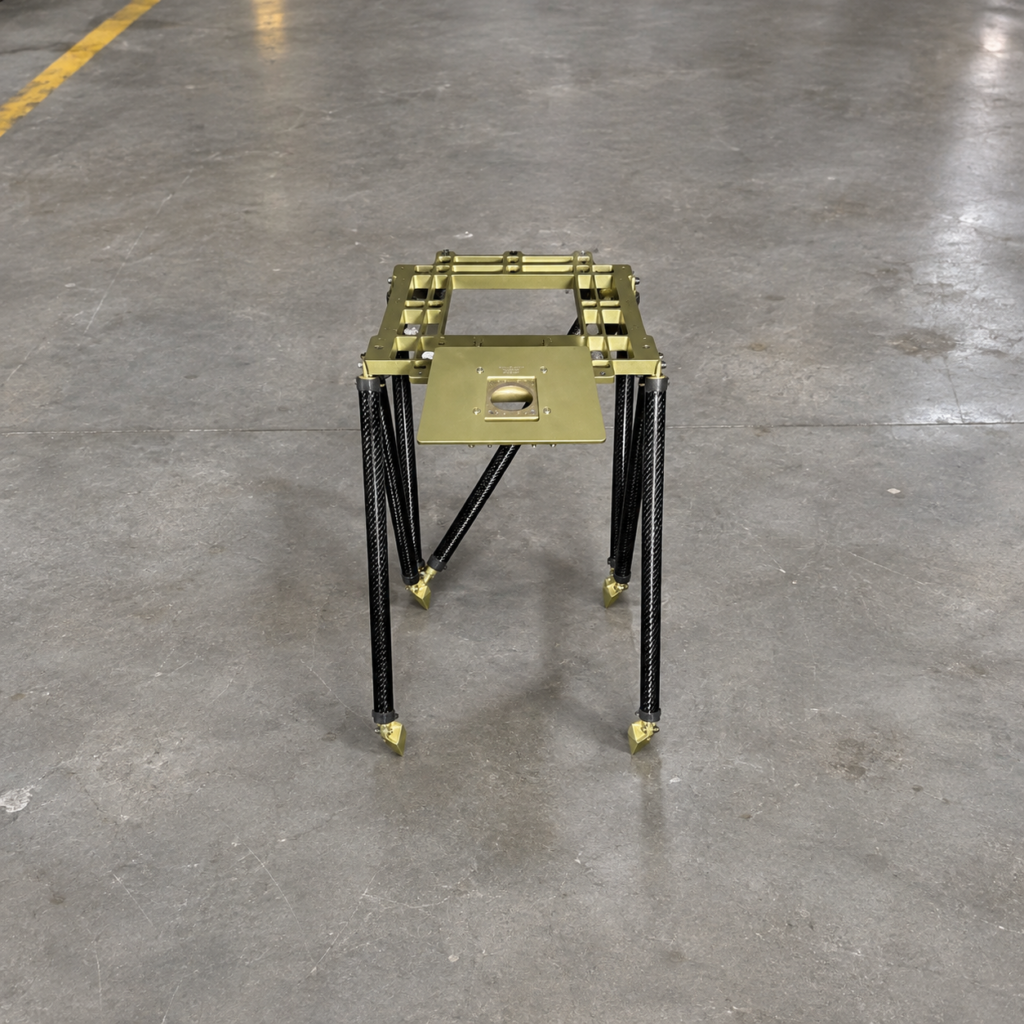
Low-expansion alloy satellite optical mounts help lenses, mirrors, detectors, and laser components remain aligned when spacecraft temperatures change. Even a small dimensional shift can move an optical surface, change the focal distance, or tilt the instrument’s line of sight.
The mount must survive launch vibration, hold its adjustment without maintenance, and remain stable through repeated thermal cycles in orbit. Low thermal expansion is therefore often more important than simply choosing the lightest or strongest metal.
The Satellite Moves from Sunlight into Shadow
A spacecraft may experience changing solar exposure as it orbits, changes attitude, or operates heaters and electronic equipment. Components do not necessarily reach the same temperature at the same time.
One side of an optical mount may warm first while another remains shaded. The resulting temperature difference can cause both uniform expansion and local bending.
For a component of length L, the approximate dimensional change is:
ΔL = α × L × ΔT
Here, α is the coefficient of thermal expansion, and ΔT is the temperature change. A lower coefficient reduces dimensional movement for the same mount size and temperature variation.
A Small Movement Becomes an Optical Error
A mechanical displacement that appears negligible on a conventional structure may be significant in a precision optical instrument.
Axial movement between a mirror and detector can produce defocus. Lateral movement may shift an image across the focal plane. Angular change in a mirror mount can alter the instrument boresight or direct a laser away from its intended target.
The sensitivity can become greater when several mounts move in different directions. Their individual errors combine through the optical path rather than remaining isolated at one component.
NASA notes that spacecraft optical benches must maintain precise pointing and alignment through launch, thermal loading, and on-orbit jitter. Low-expansion mounts reduce the amount of correction required from focus mechanisms, steering mirrors, or image-processing systems.
Temperature Gradients Can Tilt the Mount
A low average expansion coefficient does not guarantee perfect stability. If one side of the mount is warmer than the other, unequal expansion can bend or rotate the structure.
Geometry, wall thickness, heat paths, surface coatings, and nearby electronics all influence this thermal deformation. A thick asymmetric mount may respond more slowly and develop larger gradients than a thin, balanced structure.
Designers therefore combine low-expansion materials with thermal insulation, heaters, radiators, conductive straps, and symmetrical structural layouts. The material reduces the dimensional response, while thermal control limits the temperature difference that causes it.
The Mount Must Match the Optic and the Bench
An optical mount is connected to both an optic and a supporting bench. If their expansion coefficients differ greatly, the interfaces can generate stress as temperature changes.
A rigid metal clamp around a low-expansion glass or ceramic optic may squeeze or pull the optic during cooling. This can distort its surface, introduce birefringence, damage a coating, or crack the optic near the contact points.
At the opposite interface, an Invar mount attached directly to an aluminum optical bench can experience differential movement because aluminum expands much more. The joint may shift, bend the mount, or load the fasteners.
Flexible blades, bipods, compliant adhesive layers, kinematic contacts, and matched interface materials can isolate these differences. The lowest-expansion alloy is not useful if the joint transfers excessive strain from another structure.
Invar Is Common, but It Is Not the Only Choice
Invar 36 is a well-known iron-nickel alloy with a very low coefficient of thermal expansion near room temperature. It has been used in spacecraft optical benches and precision mounts where dimensional stability is critical.
Super Invar can provide still lower expansion over a limited temperature range. Kovar is valuable where expansion must be matched to certain glasses or ceramics, particularly in sealed assemblies.
Other systems use titanium, stainless steel, aluminum, carbon-fiber composites, silicon carbide, beryllium, or glass ceramics. Some of these materials do not have the lowest absolute expansion but may offer a better overall combination of stiffness, mass, thermal conductivity, operating temperature, and interface compatibility.
NASA’s James Webb Space Telescope, for example, uses beryllium mirrors because the material combines low density, high rigidity, and low thermal expansion at cryogenic temperatures.
Low Expansion Comes with Trade-Offs
Invar has a density similar to steel, so a solid Invar mount may add significant launch mass. It can also be difficult to machine efficiently and may require controlled heat treatment to achieve stable dimensions.
Low thermal conductivity can slow temperature equalization and allow gradients to remain across the mount. Magnetic behavior may be unacceptable near some sensors. Corrosion protection, outgassing, cleanliness, and coating compatibility must also be reviewed.
Material properties can vary with temperature and processing history. A coefficient stated near room temperature may not represent performance at cryogenic or elevated operating conditions.
For this reason, the material must be evaluated over the mission’s complete temperature range rather than selected from a single room-temperature value.
Stability Must Continue After Machining
Machining removes material and redistributes residual stress. A precision mount can therefore change shape after unclamping, thermal cycling, or long-term storage.
Production may include rough machining, stress relief, dimensional stabilization, finish machining, and precision inspection. The sequence depends on the alloy and the required tolerance.
Interfaces for optics should also control flatness, position, and contact pressure. Tightening a fastener unevenly can introduce more optical distortion than thermal expansion would have caused.
Thermal-Vacuum Testing Confirms the Design
Room-temperature inspection cannot prove that an optical mount will remain aligned in orbit. Critical assemblies are tested through representative hot and cold conditions in a thermal-vacuum chamber.
Engineers may monitor mirror position, wavefront error, focus, boresight, strain, and temperature while the system cycles. Vibration testing then verifies that the same lightweight structure can also survive launch.
The objective is not to eliminate all thermal movement. It is to keep the resulting optical error within the instrument’s allowable budget and make any remaining change predictable.
Low-expansion alloys provide a stable mechanical reference, but successful satellite optical mounting still depends on compatible interfaces, thermal control, structural stiffness, manufacturing stability, and complete assembly testing.