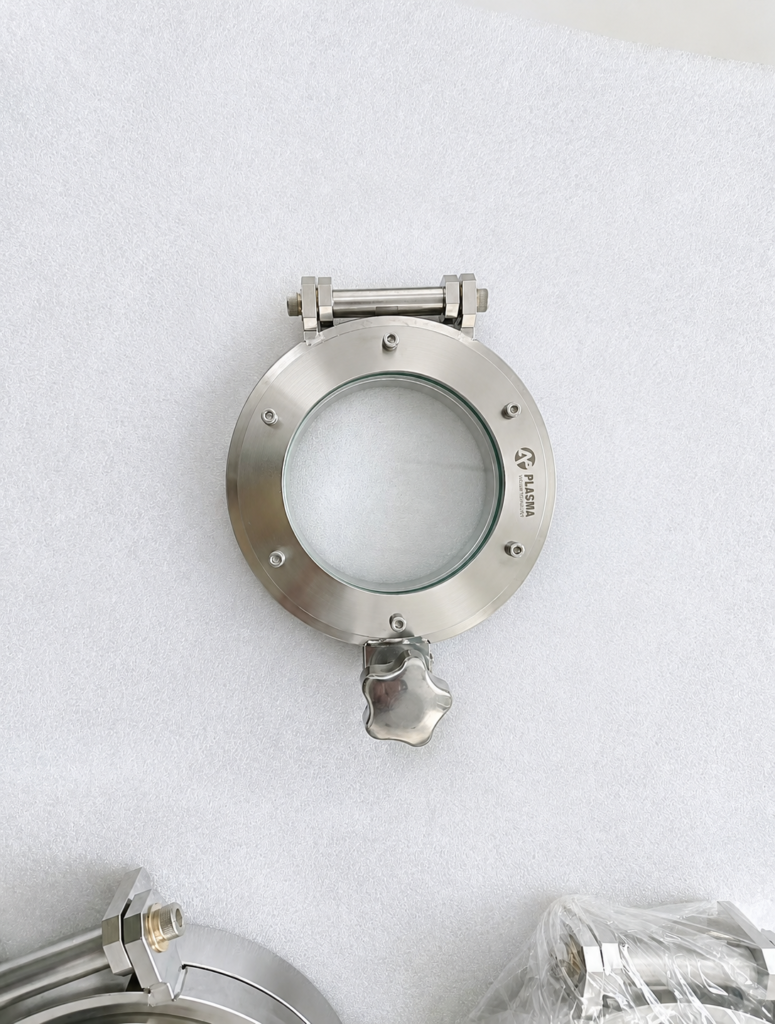
Vacuum viewport retaining ring thermal expansion must be controlled because the metal ring, transparent window, housing, and sealing element do not expand by the same amount when temperature changes.
At room temperature, the assembly may have the correct clamping force and pass a helium leak test. During vacuum bakeout or process heating, unequal expansion can increase or reduce that force. The result may be a cracked window, permanent optical distortion, a damaged seal, or a leak that appears only at elevated temperature.
Everything Fits Before Heating Begins
A mechanically retained viewport normally includes a glass, fused-silica, sapphire, or other transparent window supported by a flange or housing. A metal ring applies the load needed to hold the window and compress the gasket or sealing element.
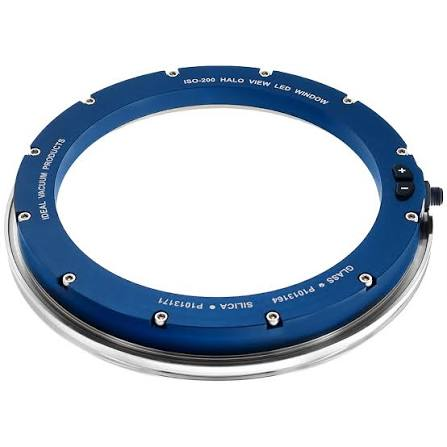
The assembly must produce enough force to maintain vacuum integrity without concentrating excessive stress at the edge of the window. This balance is already narrow because transparent materials are generally much less tolerant of localized tensile stress than ductile metals.
Surface flatness, ring stiffness, gasket thickness, fastener torque, and contact geometry all affect the initial load. Thermal expansion then changes that load after the chamber begins to heat.
The Metal Ring Usually Moves Farther
Many stainless steels and aluminum alloys have higher coefficients of thermal expansion than fused silica and some other optical materials. As temperature rises, the metal ring can grow radially and axially by a greater amount than the window.
The difference may appear small when expressed per degree, but it accumulates across the component diameter and the complete temperature change. A large viewport exposed to a high bakeout temperature can therefore experience considerably more differential movement than a small window operating near room temperature.
The gasket, spring element, or flexible ring feature must absorb this movement without losing sealing pressure or transferring a dangerous load into the window.
Heating Can Increase or Reduce the Clamping Force
Differential expansion does not produce only one predictable failure mode. Its effect depends on the ring geometry, fastener arrangement, housing material, contact location, and seal design.
In one assembly, ring expansion may increase compression against the window. Excessive load can cause edge chipping, radial cracking, or delayed fracture after repeated thermal cycles.
In another design, expansion may reduce the effective preload. The gasket can then lose contact pressure, allowing a temporary leak during heating. After cooling, the viewport may appear normal again, making the problem difficult to reproduce during a room-temperature inspection.
This is why tightening the ring more strongly is not a safe general solution. Extra room-temperature preload may simply move the failure from leakage to glass damage.
Temperature Gradients Create a Second Stress
Even when the average coefficients of thermal expansion are compatible, uneven heating can distort the assembly. The metal flange may heat before the center of the window, or process radiation may heat one side more rapidly than the other.
The hotter region tries to expand while the colder region restrains it. The resulting thermal gradient can bend the window and add stress to the load already produced by the retaining ring.
Kurt J. Lesker recommends cautious heating of viewports and warns against rapid temperature changes and gradients. For some viewport products, a ramp rate of approximately 2–3°C per minute is recommended.
The permissible rate is product-specific, so the viewport manufacturer’s limit should take priority over a general bakeout rule.
Seal Compression Must Remain Within Its Working Range
Elastomeric, polymer, metal, and glass-to-metal sealing systems respond differently to thermal cycling. A resilient gasket can accommodate some movement, but its stiffness, compression set, outgassing, and temperature limit must still be considered.
NASA guidance for bolted glass windows notes that the gasket must accommodate the dimensional difference between glass and metal while maintaining the seal without overloading the window.
For ultra-high-vacuum systems, the design may use brazed, soldered, or compression-based sealing arrangements rather than a conventional elastomer gasket. In these assemblies, matching expansion behavior becomes even more important because the sealing layer may have limited ability to absorb strain.
Optical Performance Can Change Before the Window Fails
A viewport does not need to crack or leak before thermal expansion becomes a problem. Uneven ring pressure can slightly bend the window or introduce stress birefringence.
For ordinary visual observation, this may be acceptable. For laser transmission, interferometry, spectroscopy, or imaging, a small deformation can shift focus, disturb polarization, or change the optical path.
The retaining ring must therefore apply a uniform, repeatable load around the circumference. Ring flatness, parallelism, contact width, surface finish, and fastener tightening sequence can be as important as the nominal material coefficient.
Low-Expansion Metal Is Not Always the Automatic Answer
Invar, Kovar, stainless steel, nickel alloys, and aluminum each offer different combinations of thermal expansion, stiffness, corrosion resistance, weldability, magnetic behavior, vacuum compatibility, and cost.
Kovar is widely associated with matched glass-to-metal seals, but it is not automatically the best material for every removable retaining ring. The correct choice depends on the window material and on whether the ring directly constrains the window or loads it through a compliant gasket.
Designers may also control expansion through geometry rather than material alone. Spring washers, flexures, thin compliant sections, segmented rings, and controlled gasket compression can maintain preload while allowing differential movement.
Verification Must Include the Temperature Cycle
Room-temperature dimensions and leak testing cannot fully validate a heated viewport. Critical assemblies should be checked through the intended bakeout or operating-temperature range.
Verification may include controlled ramp testing, helium leak testing before and after cycling, fastener-preload review, window-flatness measurement, and inspection for edge damage. Optical systems may also require wavefront or polarization testing at operating temperature.
The aim is not to make every component expand identically. It is to ensure that the unavoidable difference in expansion remains within the compliance and strength limits of the complete viewport assembly.