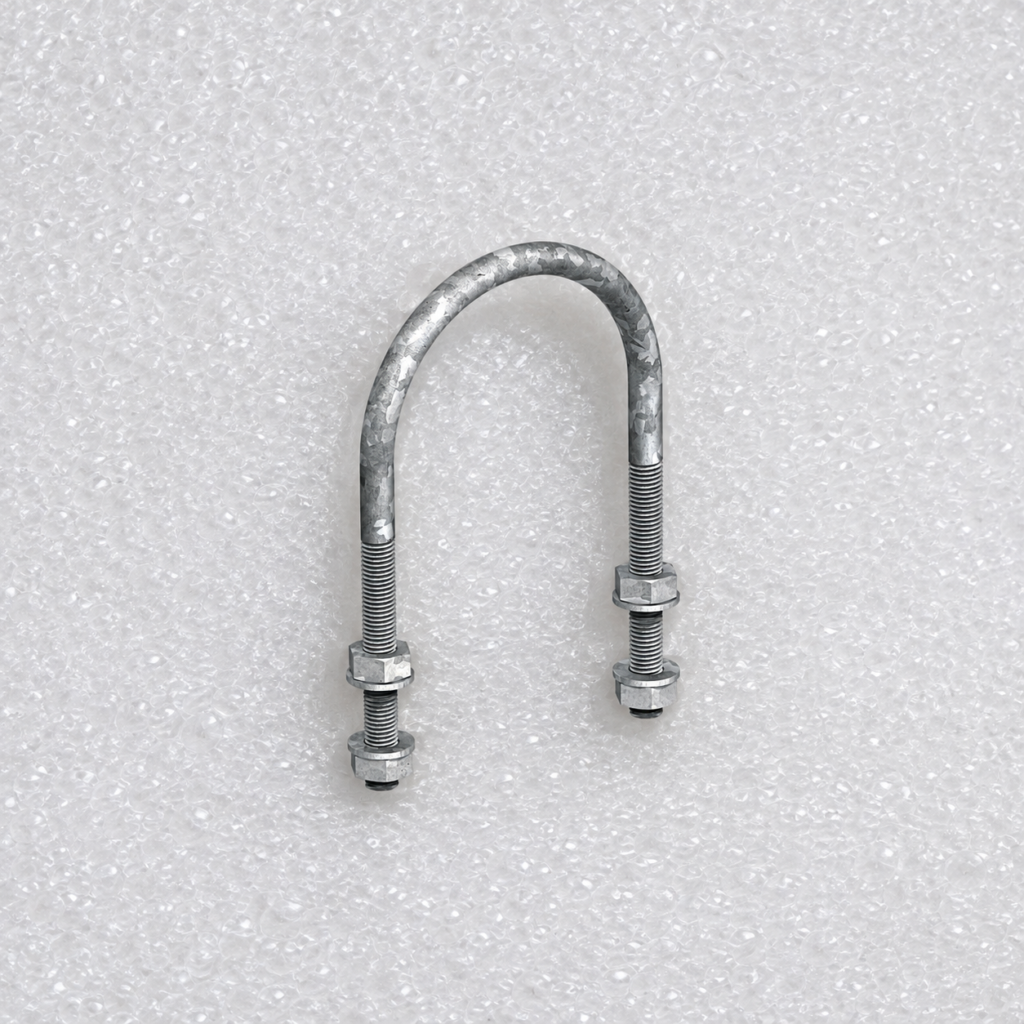
U-bolt coating cracks usually form because a brittle or excessively thick coating is forced to follow severe plastic deformation at the bend. Prevention begins with the manufacturing sequence: form the U-bolt first, complete any required heat treatment, and apply the protective coating afterward.
Why the Bend Is the Weakest Area
During forming, the outside of the U-bolt bend is stretched while the inside is compressed. The highest tensile strain normally occurs at the outer crown, making this the first location where a rigid coating separates or cracks.
Failure becomes more likely when the bend radius is too small, the bar surface contains tooling marks, coating thickness is excessive, or adhesion is poor. Cracks can then allow chemical vapors, wash water, or process liquid to reach the steel and spread corrosion beneath the surrounding finish.
Form First and Coat Last
Applying the final coating before bending should be avoided whenever possible. Even if the surface initially looks intact, microscopic cracks may develop and become visible only after installation or environmental exposure.
A more reliable manufacturing route is:
- Cut and prepare the steel bar
- Roll or form the threads
- Bend the U-bolt to its final geometry
- Complete heat treatment or stress relief if required
- Remove scale, oil, and forming residue
- Apply the selected coating system
- Inspect the bend and threaded areas
Welding, thread repair, grinding, and dimensional correction should also be completed before the final coating.
Improve the Bend Geometry
A larger bend radius reduces strain at the outer surface and gives the coating a smoother transition. The forming die should not leave grooves, dents, sharp impressions, or metal pickup at the bend.
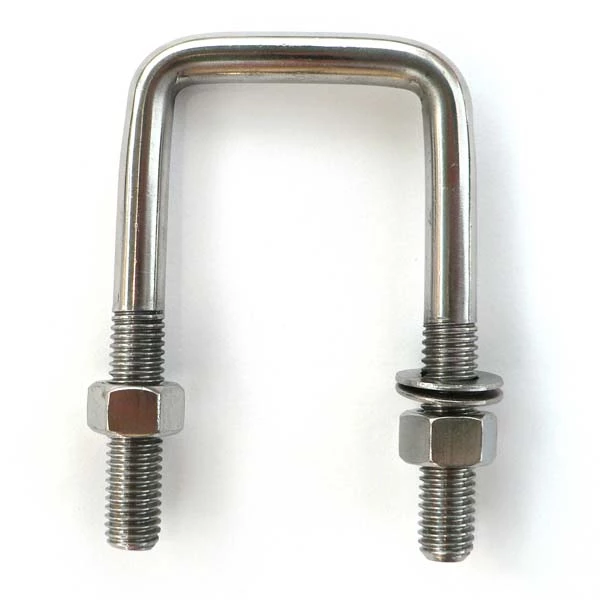
Surface defects created before coating become stress concentrators and corrosion initiation points. Bar diameter, alloy strength, material condition, forming temperature, and springback should therefore be considered when specifying the minimum bend radius.
If a finished U-bolt must be adjusted after coating, the permitted correction angle and tool-contact location should be clearly limited and validated.
Select a Coating Compatible with the Fastener
Non-electrolytically applied zinc-flake systems are often suitable for formed U-bolts. They provide corrosion protection with relatively low coating thickness and can include topcoats that control chemical resistance and friction.
ISO 10683 specifies zinc-flake coating systems for steel fasteners. These systems are especially used on high-strength fasteners to reduce the risk of internal hydrogen embrittlement associated with some electrolytic processes.
Electroplated zinc or zinc-nickel can provide a thinner and more uniform finish, but the plating should be applied after bending. High-strength steel requires careful control of cleaning, pickling, plating, and post-coating baking. ISO 4042 includes requirements and recommendations for minimizing hydrogen-embrittlement risk in electroplated fasteners.
Hot-dip galvanizing offers a thicker sacrificial zinc layer for severe outdoor or industrial exposure. However, it can create greater dimensional buildup on threads and uneven accumulation around curved areas. ISO 10684 covers hot-dip galvanized coatings for defined sizes and strength classes of threaded fasteners.
Organic coatings can provide good chemical resistance, but thick epoxy or powder layers should not be bent after curing. Flexible primers and topcoats must still be tested on the actual bend geometry.
Do Not Ignore the Chemical Environment
A coating that survives forming may still fail in service if it is incompatible with the process medium. Acid vapor, alkaline cleaning solution, chloride deposits, fertilizer, solvents, and high temperature affect zinc, nickel, and organic finishes differently.
For chemical equipment, coating selection should be based on actual concentration, temperature, exposure time, condensation, and maintenance conditions—not salt-spray hours alone.
Areas beneath clamps, washers, and mounting plates also require attention because trapped liquid can create crevice conditions. Sealants or isolating washers may be needed where the U-bolt contacts a dissimilar metal or coated pipe.
Inspect the Actual Bend
Flat test panels cannot reproduce the strain, thickness distribution, and drainage behavior of a U-bolt. Validation should therefore include production-representative finished parts.
Inspection should check the outer crown, inner radius, thread runout, and tool-contact marks. Useful verification includes coating-thickness mapping, magnified crack inspection, adhesion testing, corrosion exposure, dimensional checks, and assembly testing.
If the coating contains an integral lubricant, the torque–clamp relationship must also be verified. Excessive or inconsistent friction can alter preload even when corrosion performance is acceptable.
Conclusion
Preventing U-bolt coating cracks requires more than choosing a flexible finish. The U-bolt should be formed before coating, designed with an adequate bend radius, cleaned without damaging high-strength steel, and coated with a system suitable for the chemical environment. Final validation must examine the actual bend rather than relying only on flat coated samples.