Start With the Operating Environment
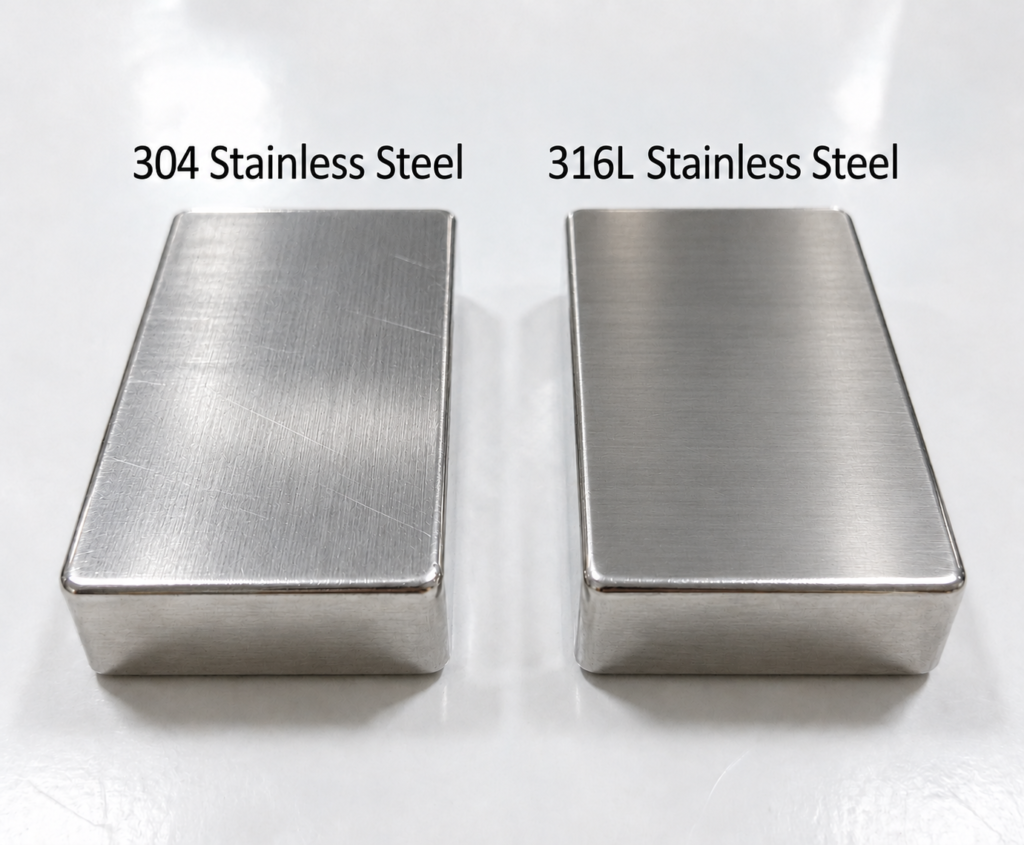
The choice between 304 vs 316L stainless steel should not be based only on whether a component touches food. Both grades are widely used in food-processing equipment, but their corrosion resistance differs under salt, acid, heat, and repeated cleaning.
A practical material decision begins with four questions:
- Does the part contact food directly?
- Does the product contain salt or organic acids?
- Which cleaning and sanitizing chemicals are used?
- Will the component be welded or exposed to stagnant liquid?
The answers usually make the correct grade much clearer.
When 304 Stainless Steel Is Sufficient
Grade 304 is a cost-effective choice for general food-processing environments with limited chloride exposure. It offers good corrosion resistance, cleanability, fabrication performance, and availability.
Typical applications include:
- Machine frames and protective covers
- Bakery and dry-food equipment
- Hoppers for non-corrosive ingredients
- Tables, brackets, and handling components
- External housings and non-product-contact parts
For equipment processing dry powders, grains, sugar, or similar products, 304 often provides adequate performance. It may also be suitable for product-contact parts when operating temperatures are moderate and cleaning solutions are properly controlled.
Its lower material cost makes 304 attractive for large components and production quantities where the additional corrosion resistance of 316L is unnecessary.
When 316L Is the Safer Choice
Grade 316L contains molybdenum, which improves resistance to pitting and crevice corrosion, particularly in chloride-containing environments.
Consider 316L for equipment exposed to:
- Salt, brine, sauces, or seafood
- Acidic products containing both acid and salt
- Frequent wet cleaning or clean-in-place cycles
- Chloride-containing water or sanitizers
- Warm, humid, or continuously wet conditions
- Areas where liquid may collect around seals or joints
Examples include valves, pump components, spray nozzles, mixer parts, filling-system components, and product-contact fittings.
However, 316L is not immune to corrosion. High chloride concentration, elevated temperature, long chemical contact time, and poorly drained crevices can still damage the surface. More highly alloyed or duplex stainless steels may be required in unusually aggressive environments.
Why Does the “L” Matter?
The “L” in 316L indicates a lower carbon limit. This reduces the risk of chromium carbide formation in heat-affected areas during welding, helping preserve corrosion resistance around properly produced welds.
This makes 316L particularly useful for welded tanks, pipe fittings, manifolds, and other hygienic assemblies. Weld quality remains essential: rough beads, incomplete penetration, heat tint, and uncleaned welds can create contamination or corrosion risks regardless of the alloy.
Material Grade Is Only Part of Hygienic Design
Selecting 316L does not automatically make a part more hygienic than a well-designed 304 component. Surface condition and geometry are equally important.
Food equipment parts should avoid:
- Deep scratches and machining marks
- Sharp internal corners
- Unsealed threads in product-contact areas
- Crevices that trap food or cleaning solution
- Poorly finished or contaminated welds
- Surfaces that cannot drain completely
Appropriate machining, polishing, cleaning, and passivation help restore and maintain the protective surface. The required surface finish should be specified according to the application rather than assumed from the material grade.
Does CNC Machining Affect the Choice?
Both grades can be CNC machined successfully. However, 316L generally requires closer control of cutting heat, work hardening, chip formation, and tool wear.
Sharp tools, rigid setups, stable feeds, effective coolant delivery, and controlled finishing passes are important. Food-contact parts must also be protected from carbon-steel contamination during machining and handling.
The higher material and machining cost of 316L should be compared with the potential cost of corrosion, cleaning problems, and early replacement.
Final Selection
Choose 304 stainless steel for dry, mildly corrosive, or non-product-contact applications where cost efficiency is important.
Choose 316L stainless steel for salty, acidic, wet, welded, or frequently sanitized product-contact components that need greater resistance to localized corrosion.
The final decision should consider the actual food product, chloride level, temperature, cleaning process, surface finish, and component design—not the grade name alone.